



Italian investigators have seized mobile phones, computers, tablets, USB drives and a hard drive belonging to the five divers who died in a cave in Vaavu Atoll on May 14, as prosecutors in Rome widen a culpable homicide investigation into the tragedy. The equipment was returned to Italy by Stefano Vanin.
Monica Montefalcone, Giorgia Sommacal, Muriel Oddenino, Federico Gualtieri and Gianluca Benedetti were reported missing after they failed to surface from the dive. Benedetti’s body was recovered on May 14, and the other four were found on May 18 by three Finnish cave specialists deployed by DAN Europe: Sami Paakkarinen, Patrik Grönqvist and Jenni Westerlund.
The devices, which are now being held by investigators in Malé, could help reconstruct what happened inside the cave. Italian authorities have asked for access to GoPro cameras, dive computers and other equipment recovered from the bodies, hoping to learn depths, timings, gas usage and possibly obtain video footage of the final moments.
The search itself turned deadly. Rescue diver Staff Sergeant Mohamed Mahudhee of the Maldives National Defence Force died during the initial effort to find the missing group, adding another loss to a case that has already drawn intense scrutiny from both Maldivian and Italian investigators.
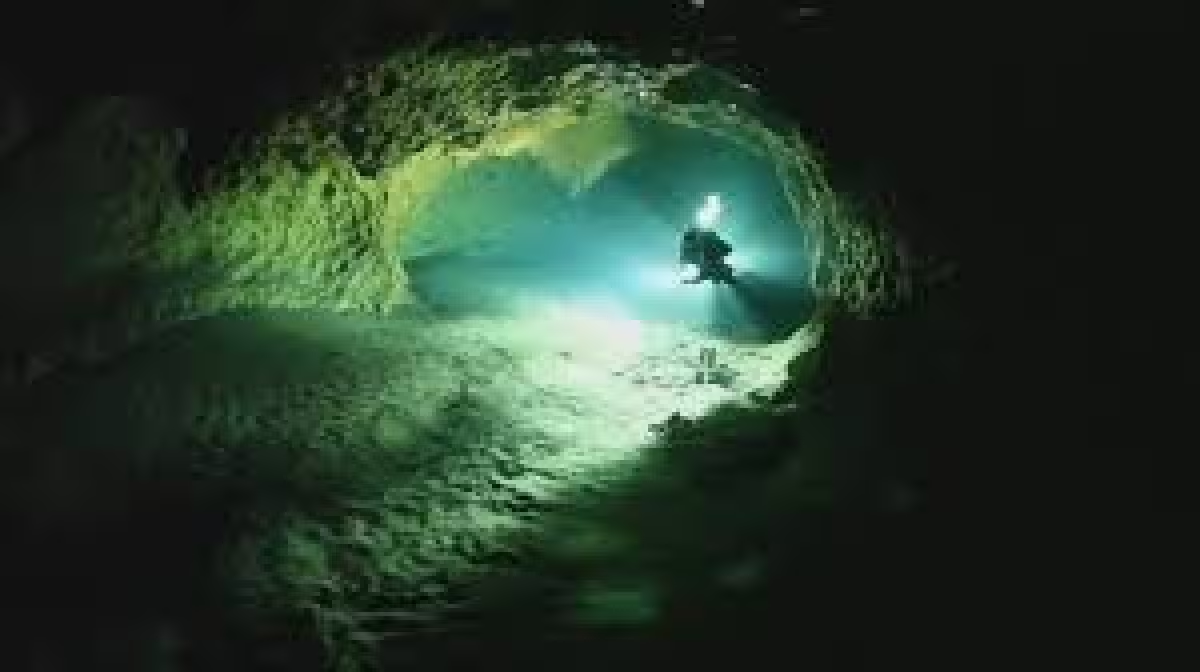
What emerges from the facts so far is not a simple equipment failure but a chain of decisions inside a difficult underwater system. The tragedy centers on a cave in Vaavu Atoll referred to in local reports as Devana Kandu or Dhekunu Kandu, and the current working view is that the divers entered voluntarily and then became trapped after mistaking a dead-end tunnel for the exit. That explanation fits the recoveries and the search data better than a random drift into the cave.
Paakkarinen has said he thought it unlikely the divers entered by accident. He described the site as a massive cave and argued that in the Maldives daylight reaches far underwater. “It’s a huge cave,” he said. “And besides, in the Maldives, the sun shines up to, I think, 100 metres deep. So at 60 metres it’s still daylight, and when you enter a cave, you know it because it gets dark. You don’t risk accidentally entering a cave.”
That view also challenges a separate theory advanced by Alfonso Bolognini, who proposed a Venturi effect based on sketches of the cave’s entrance. Paakkarinen pushed back on that idea and said, based on his experience, he did not see it as the most plausible explanation. “I can only comment based on my experience,” he said.
The coming value of the seized devices is clear. If the gear still holds usable data, investigators may be able to test the sequence of the dive, confirm whether the group moved deeper into the cave on their own, and determine whether a current or some other force altered their route. For now, the strongest evidence points toward a fatal navigational mistake inside a cave that turned back on itself.
