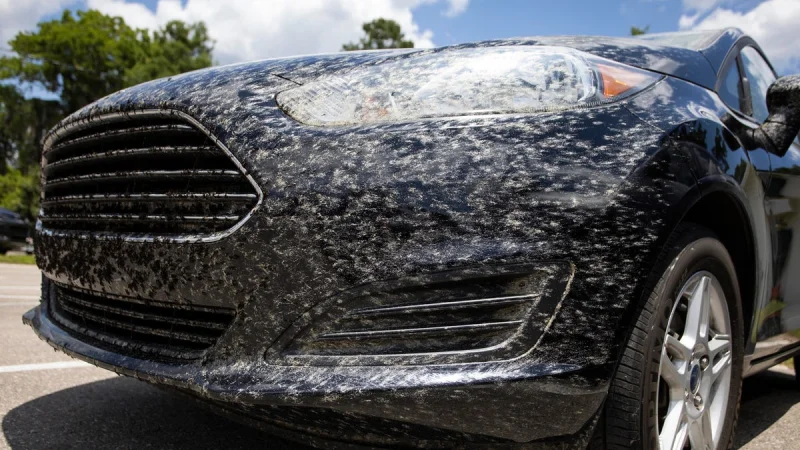
Florida’s first lovebug season of 2026 is winding down, but the insects are not going away. More swarms are expected in the fall, with Central and Southwest Florida seeing the heaviest activity so far this year.
Norman C. Leppla, who has studied the lovebug since 1972, has watched the pattern long enough to know the season follows its own clock. Female lovebugs typically emerge in swarms in April and May, then again in August and September for mating. The adults live only about three to four days, but in that brief span up to eight males can compete for each female.
That short life still leaves a lasting impression on drivers and backyard gardeners, especially when the insects gather by the thousands. Lovebugs are always present in Florida, but they are most visible during those spring and late-summer bursts, and the timing usually starts earlier in South Florida than in North Florida.
The state’s long relationship with the insect goes back decades. Lovebugs moved up Florida in the 1960s and reached North Florida in the 1970s. Leppla published his paper “Living With Lovebugs” in 2018, years after he began his work, and the basic message has remained the same: the insects are part of life in Florida whether people like them or not.
What has changed is their abundance. Residents and scientists have both noticed a decline in lovebug infestations in recent years, and the lighter showing has become noticeable enough to draw attention. A 2021 study from the Entomological Society of America discussed possible causes of insect decline more broadly, while researchers at the UF/IFAS Extension suggested in 2022 that predators may be involved in the lovebug drop.
That decline has also revived a stubborn myth that the University of Florida created lovebugs in a lab by manipulating DNA to control mosquito populations. It did not. Lovebugs are invasive to Florida, but they are not native to the state and were not manufactured there.
For now, the first wave of 2026 is nearly over. The quiet will not last long. If the usual cycle holds, Florida’s next lovebug surge will arrive when late summer turns to fall, and the same roads that looked clear this week will once again be dotted with pairs that never separate.