


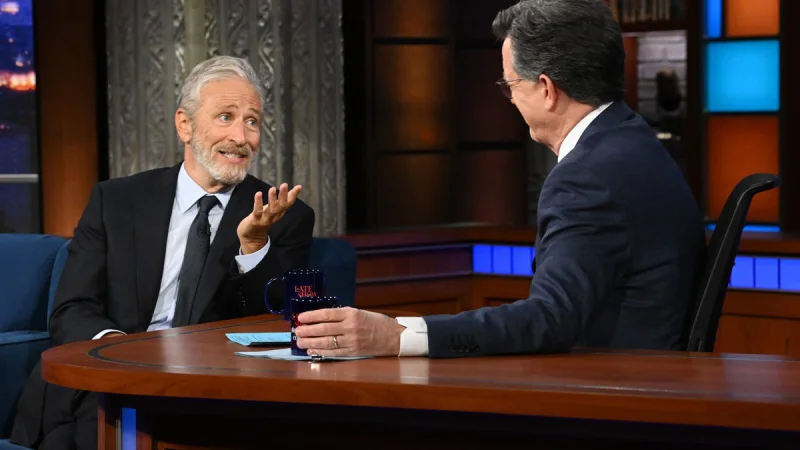
John Stewart sat down with Stephen Colbert on May 19 during the third-to-last episode of The Late Show, turning the moment into a tribute and a roast. Stewart said he was there to celebrate his friend and the joy the show had brought to so many people, and said Colbert had carried himself with “such grace through this process.”
Then Stewart went after CBS. The network canceled The Late Show in July, and he mocked the decision with a barbed line that linked the end of Colbert’s program to recent upheaval inside CBS News. “I just think it’s so smart what CBS is doing,” he said sarcastically, adding, “I just think it’s such a good move, to take this show off the air, and then to also ruin your evening news, and then reduce ‘60 Minutes’ to, like, six good ones. Here’s what I believe they’re doing: I think they’re tanking for a draft pick.”
Stewart’s jab landed because it came while CBS was already under scrutiny for how it handled the late-night franchise and its broader news operation. Several journalists left roles at CBS Evening News and 60 Minutes after Bari Weiss was hired as editor-in-chief, and critics had already alleged that ending Colbert’s show was meant to placate the Trump administration during the merger between Paramount Global and Skydance Media. CBS said in July that the cancellation was purely financial, pointing to the difficult state of late night. The merger was completed in August.

The exchange also worked because Stewart was not speaking as an outsider. Colbert rose to prominence working with Stewart on The Daily Show, then the two kept crossing paths as Stewart co-created The Colbert Report, which began in 2005 and followed The Daily Show for years before Colbert moved to The Late Show in 2015. Stewart has appeared on the program many times, and he returned to The Daily Show in 2024 after stepping away in 2015. He said on Monday that with just two days left until the final episode, Colbert was still carrying the pressure with calm, even as the network around him kept changing.
Stewart also treated the appearance as a reunion with his own past. Asked about being fired, he said, “it’s the best!” He recalled his canceled The Jon Stewart Show in 1995 and quoted David Letterman telling him, “Don’t confuse cancellation with failure,” before joking that Letterman had also said, “in this case, it is also a failure.” Colbert replied, “You now are the only person in the corporation left in late night,” and Stewart answered that his only saving grace was that he did not think Trump had cable.
He ended the visit with a gift for Colbert: a pair of luxurious reclining chairs. The gesture fit the tone of the night, which was part farewell, part insult, and part reminder that both men built careers by surviving the industry’s habits of cutting down what it no longer wants. Stewart, who now hosts Monday episodes of The Daily Show on Comedy Central, said he understood the life that remains after television decides you are done: “the life you can lead, and the life that I am leading, now that I am not really in show business.”
For CBS, the sharper question is not whether Stewart was joking. It is whether a cancellation explained as financial will ever fully escape the shadow of politics, merger pressure and the network’s own reshuffling, especially now that the show is gone and the final verdict belongs to the audience that watched it leave.
