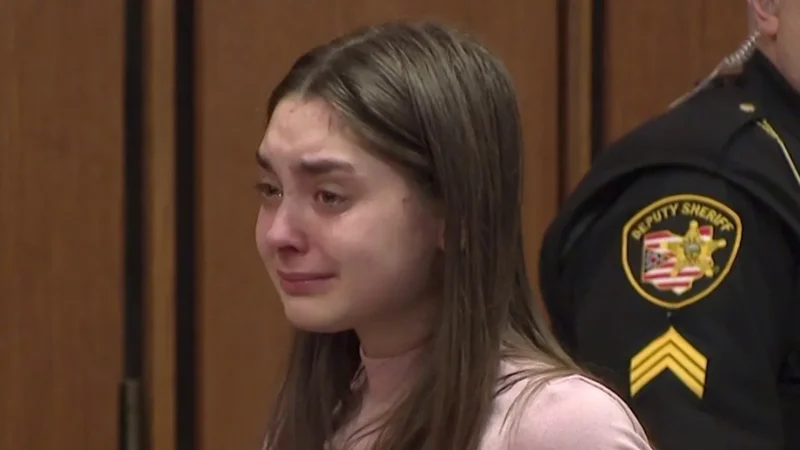
Mackenzie Shirilla’s murder case has returned to national attention after the Netflix documentary “The Crash” revisited the fatal Strongsville, Ohio, collision that killed Dominic Russo and Davion Flanagan. Shirilla, now 21, is serving two concurrent life sentences with parole eligibility after 15 years, while newly surfaced jail calls and former-inmate claims have intensified public debate over remorse, intent and the sentence imposed in the 2022 crash.
Who Is Mackenzie Shirilla?
Mackenzie Shirilla is an Ohio woman convicted of murder for a July 31, 2022, crash in Strongsville, a Cleveland suburb. She was 17 at the time and had recently graduated from Strongsville High School.
Shirilla was driving a Toyota Camry with her boyfriend, Dominic Russo, 20, and their friend Davion Flanagan, 19, inside the vehicle. The car slammed into a brick building in the Progress Drive Business Park at nearly 100 mph. Russo and Flanagan died from the impact. Shirilla survived with serious injuries.
The case initially appeared to be a devastating car crash. Investigators later focused on whether the collision was intentional, examining vehicle data, surveillance footage, relationship history and the absence of braking before impact.
Why She Was Convicted Of Murder
Prosecutors argued that Shirilla deliberately accelerated into the building after turmoil in her relationship with Russo. The vehicle’s data recorder showed the accelerator was fully pressed and the brake was not applied before the crash.
Judge Nancy Margaret Russo, who heard the case without a jury, found Shirilla guilty in August 2023. The judge described the crash as a deliberate act and said Shirilla had chosen a course of “death and destruction.”
Shirilla was convicted on multiple counts, including murder, felonious assault, aggravated vehicular homicide, drug possession and possessing criminal tools. The court also permanently suspended her driver’s license.
Her defense has maintained that the crash was not intentional and has pointed to the possibility of a medical episode or loss of consciousness. The trial court rejected that explanation, and the conviction remains in place.
Mackenzie Shirilla Sentence And Parole Eligibility
Shirilla received two concurrent sentences of 15 years to life in prison. Because the sentences run at the same time, her earliest parole eligibility is widely listed as 2037.
That does not mean she will automatically be released. A parole board would consider her prison record, rehabilitation, the facts of the crime, input from victims’ families and public-safety concerns before making any release decision.

The sentence reflected the court’s finding that two people were intentionally killed. Shirilla was a juvenile at the time of the crash, but she was tried as an adult, allowing the court to impose adult criminal penalties.
She is incarcerated at the Ohio Reformatory for Women. Her appeals have not overturned the conviction, and a bid for a new trial was rejected earlier this year.
Netflix’s “The Crash” Renews Public Scrutiny
“The Crash,” released on May 15, 2026, has brought the case back into public discussion. The documentary features Shirilla speaking from prison, along with courtroom material, police evidence and interviews connected to both families.
In the film, Shirilla denies being a murderer while acknowledging that she was the driver in a tragedy. That distinction has become central to the renewed debate: the court found intent beyond a reasonable doubt, while Shirilla and her family continue to dispute that conclusion.
The documentary also places fresh attention on the victims’ families, especially the continuing grief of those closest to Russo and Flanagan. For them, the case is not only a true-crime story but the permanent loss of two young men.
Jail Calls And Former-Inmate Claims Add To Debate
Public reaction intensified after recorded jail calls surfaced in which Shirilla discussed prison life and questioned whether she needed rehabilitation. In another call, she expressed fear that incarceration could affect her ability to have children and build a family after release.
A former inmate has also claimed that Shirilla behaved differently behind bars than she appeared in the documentary, describing her as upbeat and lacking visible remorse. Those claims have fueled online criticism, though they do not change the legal status of the case.
The broader issue is how the public reads remorse in a high-profile criminal case. Courtroom demeanor, prison behavior, edited documentary footage and private calls can all shape perception, but none replaces the legal record that produced the conviction and sentence.
What Happens Next
There is no new sentencing date for Mackenzie Shirilla. Her conviction and sentence remain in effect, and her next major milestone is parole eligibility unless further legal action changes the case.
The renewed attention may continue as more viewers watch “The Crash” and debate the evidence, the sentence and Shirilla’s public statements from prison. Still, the central legal facts are settled for now: she was convicted of murder, sentenced to life with parole eligibility after 15 years, and remains in state custody.
For the families of Dominic Russo and Davion Flanagan, the documentary has reopened a painful case in public view. For Shirilla’s supporters, it has revived questions about intent and punishment. For the courts, however, the judgment stands unless a future appeal or parole decision changes the outcome.