


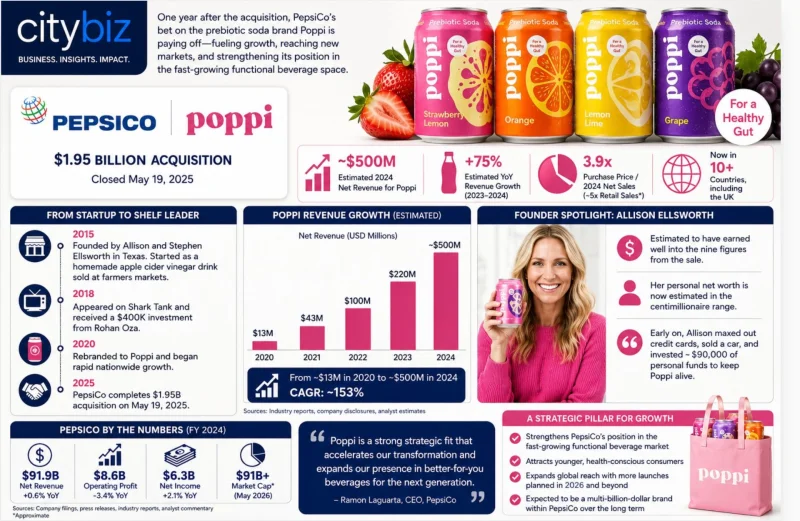
One year after PepsiCo bought Poppi for $1.95 billion, the deal has become a case study in how quickly a niche wellness drink can scale when a giant beverage company puts its weight behind it. For Allison Ellsworth, the founder who helped turn a homemade apple cider vinegar drink into a national brand, the sale appears to have delivered a fortune that several business outlets describe as well into the nine figures.
Poppi was founded by Allison Ellsworth and Stephen Ellsworth and first sold at Texas farmers' markets before it broke through on Shark Tank in 2018, where Rohan Oza backed the company with a $400,000 investment. Ellsworth has said the founders maxed out credit cards, sold a car and put in roughly $90,000 of their own money before the brand took off, a detail that fits the arc of a company that went from about $13 million in revenue in 2020 to roughly $500 million in 2024, according to industry estimates.
PepsiCo’s purchase valued Poppi at about 3.9x annual sales, though some analysts put the price closer to 5x retail sales depending on how they measured the business. The company has since used PepsiCo’s distribution muscle to push Poppi into grocery and convenience stores and, more recently, into the UK. That expansion matters because the market for better-for-you sodas has become crowded fast, and analysts say Poppi gives PepsiCo a more direct answer to Coca-Cola’s Simply Pop and to Olipop, which has reached multibillion-dollar valuations.
The brand’s rise also reflects a broader shift inside PepsiCo, where chief executive Ramon Laguarta has made clear he wants more wellness-focused food and beverage offerings. Poppi joins a string of acquisitions that includes Siete Foods and Sabra, showing the company is not just chasing flavor trends but trying to reposition itself for consumers who still want soda-like products with a healthier image.
That leaves Allison Ellsworth in an unusual place for a founder who started with a kitchen experiment and a farmers’ market table: she is now tied to one of the biggest exit stories in the beverage aisle, while the company she built is being asked to prove that a viral brand can stay relevant after the sale.
