


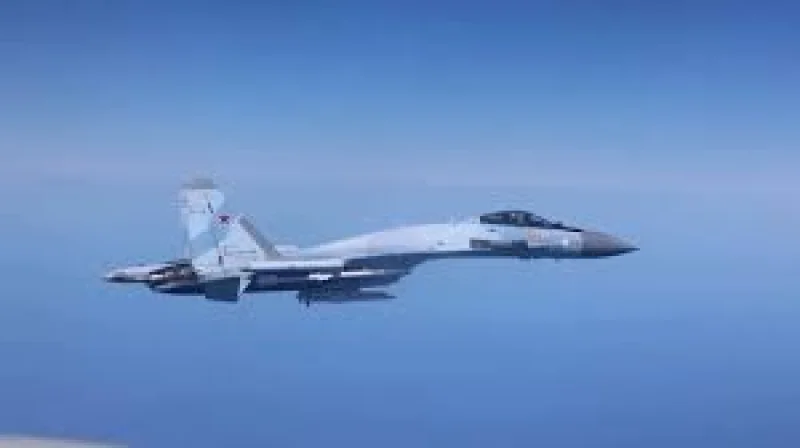
Two Russian jets intercepted an RAF spy plane over the Black Sea last month in what Britain called the most dangerous Russian action against one of its aircraft since 2022. The Ministry of Defence said the Russian warplanes repeatedly and dangerously closed in on the unarmed Rivet Joint aircraft, with one Su-35 approaching close enough to trigger its emergency systems and disable its autopilot.
A Su-27 then made six passes in front of the RAF plane and came as close as six metres from its nose, the ministry said. Defence Secretary John Healey said the pilots showed dangerous and unacceptable behaviour toward an unarmed aircraft operating in international airspace. He also praised the crew’s outstanding professionalism and said the incident created a serious risk of accidents and potential escalation.
The Rivet Joint was on a routine international flight to help secure Nato’s eastern flank when it was confronted by the Russian aircraft. The RC-135W, operated by No 51 Squadron and usually flown out of a base in Lincolnshire, carries advanced sensors that intercept and analyse signals across the electromagnetic spectrum, feeding real-time strategic and tactical intelligence to commanders. Britain said the interception came amid increased Russian aggression in the region.

The episode revived memories of September 2022, when a Russian pilot fired two missiles at an RAF Rivet Joint over the Black Sea, according to the source material. Three senior Western defence sources later told another outlet that the missile was fired after an ambiguous command from a Russian ground station. That earlier incident had already made clear how quickly routine surveillance flights in the area can turn risky.
London and the Foreign Office called on the Russian embassy to condemn the latest incident. Healey said it would not deter Britain’s commitment to defend Nato, its allies and its interests from Russian aggression. The timing matters because the Black Sea and Nato’s eastern flank remain flashpoints, and each encounter adds another layer of risk to already tense military airspace.
What happens next is simple enough to state and hard to ignore: Britain will keep flying these missions, Russia will keep testing the edges, and the margin for error stays frighteningly thin. A mission that depends on split-second judgment can survive a lot. It cannot survive a misread order, a pilot’s mistake, or one more close pass like this.
