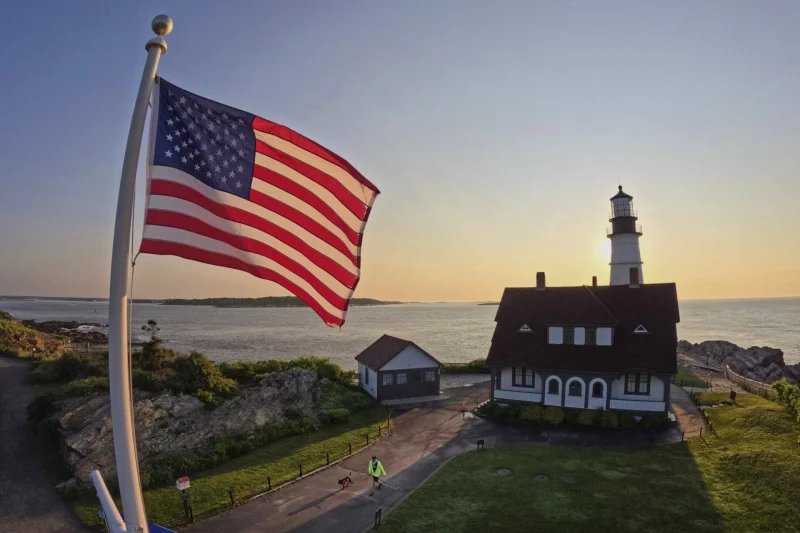
Kate Magee created a photo essay after her younger brother was wounded in an enemy rocket attack shortly after his deployment to Afghanistan, turning a family wound into a tribute to service and to the flag. In the collection, she photographs people with the Stars and Stripes and asks what the American flag means to them, then lets their answers do the work.
One of the images shows retired Marine Robert Frazier running across his family’s cornfield in Harrisonburg, Virginia. Another pairs the flag with a different kind of devotion: Mark Greenberg said being wrapped in the “flag blanket” reminded him of the many virtues symbolized by the flag, while Karen Jensen said her husband is a Vietnam veteran and that one of four flags is proudly displayed over Lake Crescent with the Olympic Mountains in the background as a sign of love, loyalty and respect for America.
The project lands now because its power comes from ordinary Americans describing the flag in the language of loss, memory and pride, not politics. It also captures how the symbol shifts with the moment: for Patrick Jackson, a photo taken at the Bolivar ferry landing in November 2015 after the Paris terrorist attack became more than a landscape when the sun behind the flag formed the image of a cross.
That same mix of private feeling and public meaning runs through the rest of the collection. Charlanne Cress said the American flags represented thousands of Louisiana soldiers who had given their lives for the country, and said her two-and-a-half-year-old grandson stood in awe of so many flags before reaching out to straighten a leaning one. Kelli Druckemiller said staring up at the beautiful flag never fails to fill her with pride, and said the fireworks illuminate the flag as it waves in the breeze. Beth Holt said people looked to the skies with pride, respect and admiration as a member of the U.S. Air Force Academy Wings of Blue precision parachute team floated above Davis-Monthan Air Force Base in Tuscan, Arizona.
Magee’s project works because it does not try to settle what the flag means once and for all. It shows that the answer changes with the person, the place and the memory attached to it, and that is what makes the collection feel alive.