


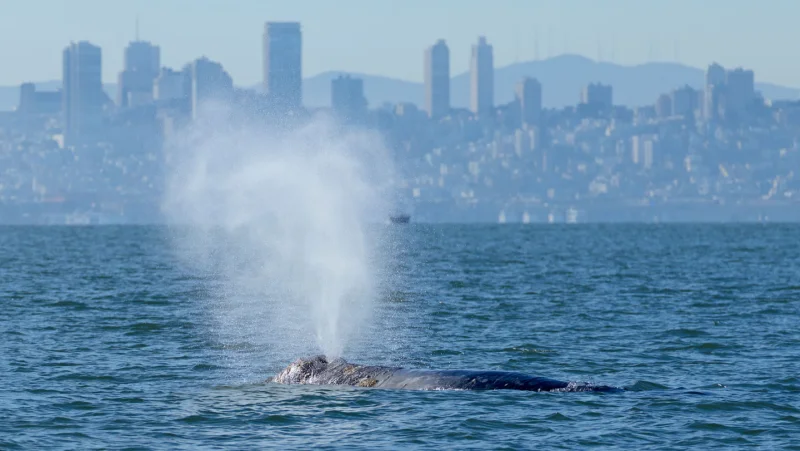
San Francisco Bay got a new line of defense against ship strikes on May 19, when scientists and maritime partners unveiled an AI-powered whale detection system meant to spot animals far enough offshore to give crews time to react. The network uses round-the-clock thermal cameras at different points in the bay and can detect whales as far as 7 kilometers away.
Daniel Zitterbart, one of the researchers behind the effort, said the goal was to identify whales far enough out to give mariners time to take action. Once a detection is confirmed by scientists, an alert is sent to nearby vessels so they can slow down or change course. The deployment was announced by a coalition that included ocean scientists, the U.S. Coast Guard, whale tracking experts and local ferry companies.
The system arrives after a rough year for gray whales in and around the bay. In 2025, 21 gray whales were found dead there, and two-fifths of those deaths were tied to ship strikes. That is the problem the new technology is built to confront. Gray whales have increasingly been foraging in one of the country’s busiest waterways, where fast-moving commercial traffic and ferry routes leave little room for error.
Scientists say the cameras are only the start. One is mounted on a radio tower on Angel Island, where it will watch busy shipping lanes. A second is set to be placed on a passenger ferry that crosses the bay every day. Future sites could include the Golden Gate Bridge and Alcatraz, widening the camera net across the water.
The system was developed by researchers at Woods Hole Oceanographic Institution and later marketed by WhaleSpotter. Building a reliable whale detection network took about 15 years, a long stretch that reflects how hard it has been to turn a moving, unpredictable animal into a dependable signal for mariners. Zitterbart said the team wants as many deployments as possible because more sites mean better eyes on the ocean. He added that shipping is not going away, and the task is to make sure the sea can still be used without shutting whales out of it.
The need for that kind of compromise has grown sharper in recent years. Researchers first noticed in 2018 that gray whales were increasingly stopping in San Francisco Bay during their southward migration, a journey of about 16,000 kilometers from feeding grounds off Alaska to mating grounds near Mexico. The species has also faced wider pressure: whale populations fell from about 20,500 in 2018 to about 14,500 in 2023, and hundreds of whales were found stranded along the North American west coast.
Climate change is part of the backdrop. Researchers say melting Arctic sea ice is disrupting the food chain that supports the amphipods gray whales feed on, making the bay’s role as a stopover more important and the riskier waterway around it more consequential. For now, the question is not whether whales will keep coming through San Francisco Bay. It is whether technology can keep pace with the traffic that meets them there.
