


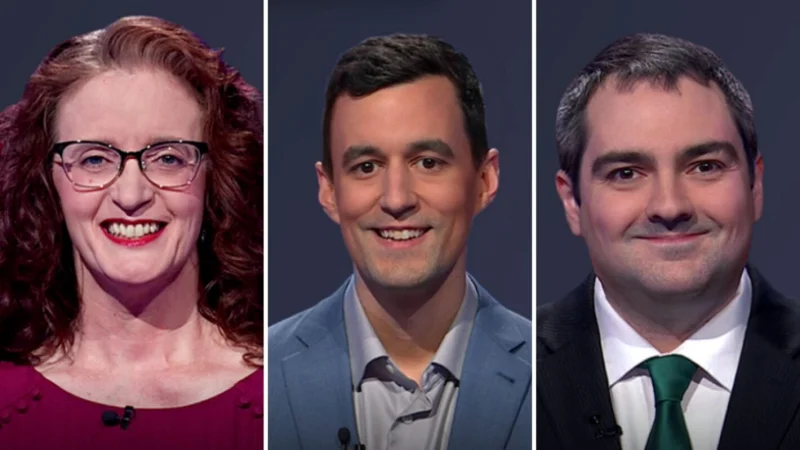
Tristan Williams opened his ninth Jeopardy! game on May 18 with the kind of pace that can change a board. The data scientist from Lincoln, Nebraska, entered with an eight-day total of $158,501 and immediately found one of the night’s turning points on clue six in “3-Word Cities,” betting everything and landing on Dar es Salaam to move to $4,000.
That early push did not settle the game. Thomas Trovato of London, Ontario, Canada, stayed close and took the lead by the first 15 clues at $4,600, while Williams sat at $4,000. Amy Dewey of Broken Arrow, Oklahoma, was still within striking distance as the round unfolded, but the board was already starting to tilt toward a fight between the two front-runners.
Williams then found another Daily Double in “All Respect to the Ballet & Opera People” on clue five and went for $6,000. The clue pointed to an Aaron Copland ballet, and Williams answered Rodeo correctly, lifting his score to $15,200 and putting distance between himself and the field. He later said “What is Rodeo?” as if the board had left him no room to think twice, and at that point it had not.
For Trovato, the key moment came on clue 11 in “LOL.” He had $7,200, bet it all, and then met a Simone de Beauvoir clue he could not answer. The score fell to $0, and host Ken Jennings said, “He doesn’t have it. That is a shame,” a line that made the miss land even harder. Jennings later added, “I’m with you. These are tough,” after Trovato described the board as especially punishing.
The Double Jeopardy board kept biting. In “Alphabetically Next,” all but one clue became Triple Stumpers, and Trovato only managed to get the board’s last clue right when he said Saturday, Sunday... was followed by Thursday on clue 29. By the end of the round, Williams led with $22,400, Dewey had climbed into second with $4,400, and Trovato sat at $1,200.
That made the night’s Final Jeopardy round less about one runaway leader than about whether anyone could recover from a board that had chewed up momentum all game. The category was “American Architecture,” and the clue asked about a building at 42nd and Lexington in Manhattan that occupied an automobile showroom on its first two floors in the 1930s. Williams went into Final Jeopardy with the lead, but the round had already shown how little safety a big number can buy when the board turns hostile.
Afterward, Trovato called the Double Jeopardy board “ToC level” and said his own experience was rough from the start, especially in the $1,600 and $2,000 rows. He said he never felt close on most of the board and only managed one $1,200 clue, which happened to be Williams’ Daily Double, just before time expired. His reaction matched the shape of the game: difficult, uneven and full of clues that did not yield easily. For Williams, the broader picture is simpler. He survived the rough board, banked another strong lead, and kept his run alive in his ninth game with $158,501 already in hand.
