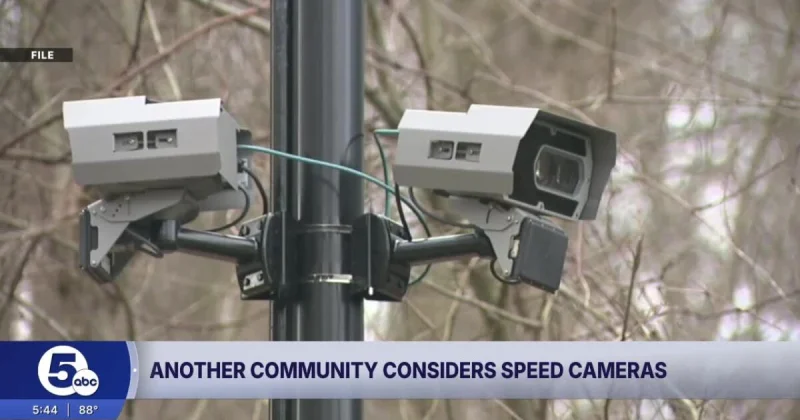
Beachwood City Council will decide whether to approve traffic cameras in the city after the proposal moved through two public committee meetings and onto the council agenda. The resolution would put cameras at seven locations across Beachwood, including school zones and a fixed spot at Chagrin and Richmond, if council gives it final approval.
The debate has already split residents. Kate Williams, who has lived in her neighborhood for 30 years, said her street is used as a cut-through and sees a steady stream of speeding drivers. “They speed right through here. They don't live here, but it's a good way to cut through,” she said. “I know you really can't stop that, perhaps, but at least draw attention to it,” she added.
Others see the cameras very differently. Burkons said she opposes the idea and called the proposal unfair. “I totally think they're not fair,” she said. “Your insurance doesn't get notified, you don't lose points. The only thing they can do if you don't pay is send you to collections.” She said the city is treating the plan as a money maker rather than a safety measure. “I think it's a money grab. They say it's about safety. If it was about safety, they would have sidewalks on Brighton. They would have better lighting on sites or things residents been asking for forever,” she said.
Beachwood Police Chief Daniel Grispino said the idea came out of a speed study that showed troubling results. “We did a speed study where I looked at the results, and some of the numbers were very alarming,” he said. Grispino argued the cameras could cut down on dangerous behavior. “If you want to see the violations and the reckless driving go down, and you want to see the crashes be reduced, this is an excellent tool that the city is going to be able to deploy to make the community safer,” he said.
If the city signs off, the system would include two handhelds on 271, a fixed camera at Chagrin and Richmond, and cameras in every school zone. Grispino said the plan is to use the cameras as a warning first, with a 30-day warning period before citations begin. Revenue from the cameras would go into a public safety fund.
Grispino also pushed back on the charge that the program is mainly about money. “Well, that's a common misconception. If it was about money, we would put them all over the city. This is not about that. It's about utilizing it as a tool. If you're obeying the speed limit, there's no issues. You're not going to get a citation,” he said.
The fight now lands with council, which has a simple choice: pass the resolution and start a traffic enforcement camera program aimed at speeding and reckless driving, or reject it and leave Beachwood looking for another answer to the problem residents and police say they both see every day.