


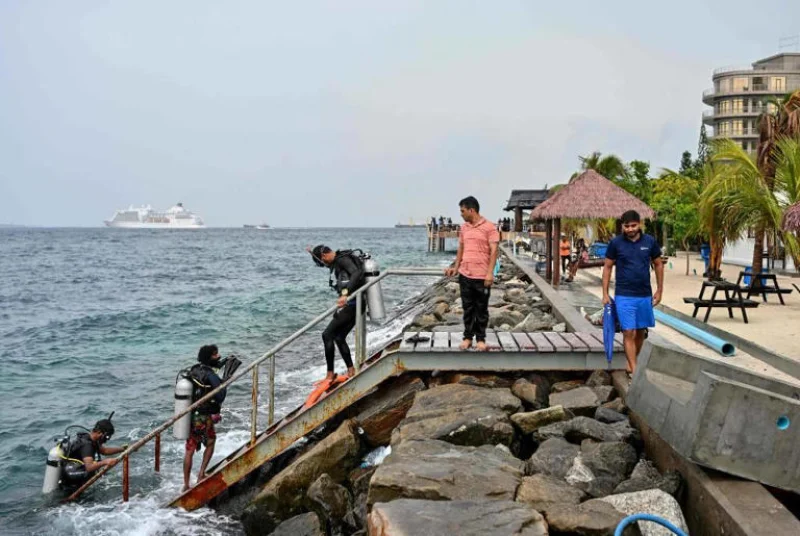
A Maldives scuba diving accident in Vaavu Atoll has become one of the country’s deadliest diving tragedies after five Italian divers and a Maldivian military diver died during a deep cave expedition and subsequent recovery effort. Authorities are still working to retrieve the remaining victims from an underwater cave near Alimathaa Island, where difficult conditions have slowed the operation and raised urgent questions about dive planning, depth limits and safety oversight.
Deep Cave Dive Turns Deadly Near Alimathaa Island
The incident began Thursday, May 14, when a group of Italian divers entered a deep underwater cave system in Vaavu Atoll, a region known for strong currents, reef channels and advanced dive sites. The group was exploring a cave at a depth of roughly 60 meters, or about 200 feet, far beyond the usual recreational diving limit in the Maldives.
Five Italians were part of the dive group. The victims have been identified in public statements and family accounts as marine ecologist Monica Montefalcone, her daughter Giorgia Sommacal, researcher Muriel Oddenino, recent graduate Federico Gualtieri and diving instructor Gianluca Benedetti.
Benedetti’s body was recovered earlier in the operation. On Tuesday, May 19, recovery teams brought up two more bodies from the cave, leaving two still to be retrieved. The bodies recovered Tuesday were being transferred to the capital, Malé, for formal procedures.
Recovery Effort Becomes A High-Risk Mission
The search has been unusually difficult because of the depth, poor visibility, cave terrain and currents in the area. Those conditions make ordinary search-and-rescue methods unsafe, especially when divers must enter enclosed underwater passages where exit routes can become hard to manage.
A Maldivian military diver died during an earlier recovery attempt, raising the death toll to six and underscoring the danger faced by rescuers. After that death, authorities brought in a specialized Finnish cave-diving team with advanced technical equipment, including closed-circuit rebreathers, to continue the operation.
The outside team located all four remaining bodies inside the cave and began bringing them upward in stages. The plan involved moving victims to a shallower depth before Maldivian divers and police completed recovery and transfer procedures. Authorities expected the remaining recoveries to continue Wednesday, May 20, if conditions allowed.
Depth Limit Questions Shape The Investigation
The Maldives is one of the world’s best-known scuba destinations, but the accident has drawn attention to the difference between recreational diving and technical cave diving. Recreational dives in the country are generally limited to 30 meters, or about 100 feet. The cave involved in this accident was roughly twice that depth.
Investigators are examining whether the group went deeper than planned, whether all required permissions were in place and whether every diver was properly listed in expedition documents. The vessel used for the trip has also come under scrutiny as officials review the organization of the dive and the chain of decisions that led the group into the cave.

The investigation has not yet produced a final public explanation for what went wrong. Possibilities under review include disorientation, equipment problems, current changes, gas-management issues, poor visibility or a combination of factors. In cave diving, small errors can become fatal quickly because divers may not be able to ascend directly to the surface.
Italian University Community Mourns Victims
The tragedy has hit Italy’s academic and marine-science community especially hard. Montefalcone was a professor and marine ecologist with deep experience in coral reef research, including work connected to the Maldives. Several members of the group were linked to the University of Genoa, giving the accident a broader emotional impact beyond the diving world.
Family members and colleagues have described the victims as experienced, careful and passionate about the ocean. That has made the unanswered questions even more painful. The presence of a skilled instructor and experienced researchers has not reduced concern over whether the dive was too risky, too deep or insufficiently controlled for the conditions.
Italian authorities are also reviewing the case, and autopsies are expected to play a role in determining the final causes of death. The legal focus may depend on whether investigators find evidence of negligence, rule violations or unauthorized technical diving activity.
Maldives Tourism Faces Safety Scrutiny
The Maldives relies heavily on tourism, and scuba diving is a major part of its global image. The government has emphasized that recreational diving in the country remains broadly safe when conducted within legal limits and proper standards. Still, this accident has placed the country’s dive-safety rules under sharper international attention.
The key distinction is that this was not a routine shallow reef dive. It involved a deep cave environment, where specialized training, equipment, gas planning and emergency procedures are essential. Even experienced open-water divers may not be prepared for cave penetration or technical-depth diving without specific certification and support.
For travelers, the incident is a reminder to ask direct questions before any advanced dive: maximum planned depth, whether overhead environments are involved, what certification is required, what emergency support is available and whether the dive operator has legal authorization for the planned activity.
Final Answers May Take Time
The immediate priority remains recovery of the remaining bodies and support for the families. Once that work is complete, investigators will need to reconstruct the dive profile, review equipment, interview surviving witnesses and assess whether the expedition followed Maldivian rules.
The Maldives scuba accident has already become a devastating case for both the diving community and the country’s tourism sector. What remains unresolved is the central question facing investigators: how a dive involving experienced people entered a chain of events that left five tourists and one rescuer dead in one of the world’s most famous diving destinations.
