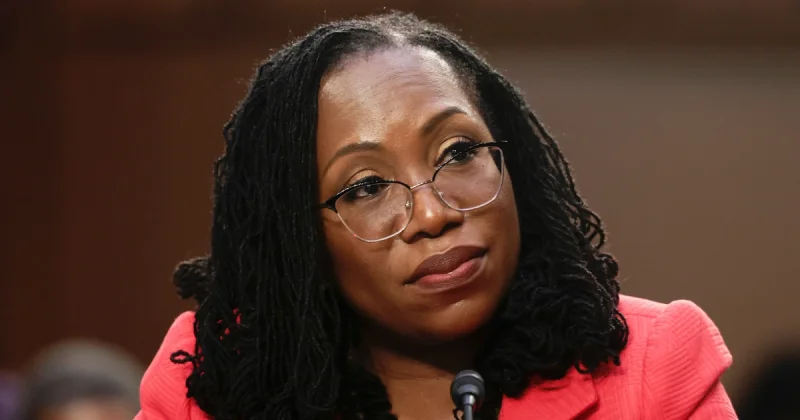
Justice Ketanji Brown Jackson is warning that the Supreme Court risks being seen as political after a major voting rights decision involving Louisiana’s congressional map, sharpening an already public split inside the nation’s highest court. Her remarks Monday night in Washington came after she issued a forceful dissent from an order that allowed Louisiana to move quickly toward new districts for the 2026 elections.
Jackson Says Public Trust Is At Stake
Jackson framed the dispute as bigger than one redistricting fight. She argued that public confidence is essential to the judiciary’s authority and that the court must be especially careful when its decisions affect elections already in motion.
The justice did not describe the court as partisan, but she warned that rulings can damage legitimacy when they appear inconsistent, rushed or detached from ordinary procedural safeguards. Her concern was aimed at how the court handled Louisiana’s map after an April decision that narrowed the role of the Voting Rights Act in redistricting cases.
The comments were unusually direct for a sitting justice speaking about a recent Supreme Court action. They also came at a sensitive moment for the court, which remains under intense public scrutiny over ethics, emergency orders, election law and the ideological divide between its conservative majority and liberal minority.
Louisiana Map Fight Drives The Dispute
The controversy centers on Louisiana’s congressional districts and whether the state could keep a second majority-Black district drawn after years of litigation.
In April, the Supreme Court’s conservative majority rejected Louisiana’s map, concluding that the state had relied too heavily on race when it created the district. The ruling said compliance with the Voting Rights Act did not justify the map’s design in that case.
Civil rights groups and voting-rights advocates argued that the decision weakened protections against vote dilution, especially in states with large Black populations and histories of racially polarized voting. Supporters of the ruling said the Constitution limits how far states may go in using race to draw electoral lines, even when they are trying to satisfy federal voting-rights law.
The immediate practical effect is significant. Louisiana lawmakers have moved toward replacing the disputed map, a change that could reduce Black voters’ ability to elect their preferred candidate in one of the state’s six House districts.
Why The Supreme Court Order Mattered Now
Jackson’s latest dissent focused not only on the earlier ruling, but also on the speed with which the court allowed the decision to take effect.
The timing is central to the dispute. Election preparations were already underway, and voting-related deadlines were approaching or already active in some parts of the process. Jackson argued that the court’s intervention created instability by forcing changes late in the election calendar.

Three conservative justices pushed back sharply, defending the court’s action and rejecting the claim that it had created improper disruption. They maintained that elections should not proceed under maps the court had found constitutionally defective.
That disagreement reflects a recurring tension in election cases: courts must decide whether to prevent a potentially unlawful map from being used or avoid last-minute changes that can confuse voters, candidates and election administrators.
Ketanji Brown Jackson’s Role On The Court Is Growing More Visible
Jackson, appointed in 2022, is the first Black woman to serve on the Supreme Court and one of three liberal justices. Since joining the bench, she has become one of the court’s most active questioners during oral arguments and one of its most pointed dissenting voices in cases involving race, executive power, criminal justice and administrative authority.
Her writing style has also drawn attention because she frequently explains the real-world effects she sees in the majority’s rulings. In the Louisiana dispute, that meant focusing on voters, district lines and election administration rather than treating the case as only a technical constitutional question.
That approach has made her a prominent figure for court watchers who see the liberal minority as trying to build a long-term record against the conservative majority’s direction. It has also drawn criticism from those who say her dissents can overstate the implications of the court’s rulings.
Voting Rights Stakes Extend Beyond Louisiana
The Louisiana case matters because Section 2 of the Voting Rights Act has long been one of the main tools used to challenge district maps that dilute minority voting strength. The law does not guarantee electoral outcomes, but it can require states to consider whether minority voters have a fair opportunity to elect candidates of their choice.
The Supreme Court’s decision did not erase Section 2, but it made the legal path more difficult in some redistricting disputes by emphasizing constitutional limits on race-conscious map drawing. That balance is now at the center of fights in multiple states as the 2026 midterm elections approach.
The outcome could influence control of the U.S. House, where a small number of district changes can carry national consequences. For voters, the stakes are more local but just as concrete: the boundaries of a district can shape representation for a decade.
Court Legitimacy Becomes Part Of The Story
Jackson’s warning adds a new institutional layer to the voting-rights debate. The question is no longer only how Louisiana should draw its congressional map, but how the Supreme Court should act when election law, race and constitutional doctrine collide.
The court’s conservative majority appears committed to tightening limits on race-based redistricting. Jackson and the other liberal justices are pressing the opposite concern: that weakening voting-rights protections could leave minority communities with less meaningful political power.
With more election cases likely before November, the Louisiana fight may not be the last time Jackson uses a dissent or public remarks to challenge the court’s direction. For now, her message is clear: the Supreme Court’s legal judgments carry consequences not only for maps and candidates, but also for whether Americans believe the judiciary is deciding cases outside politics.