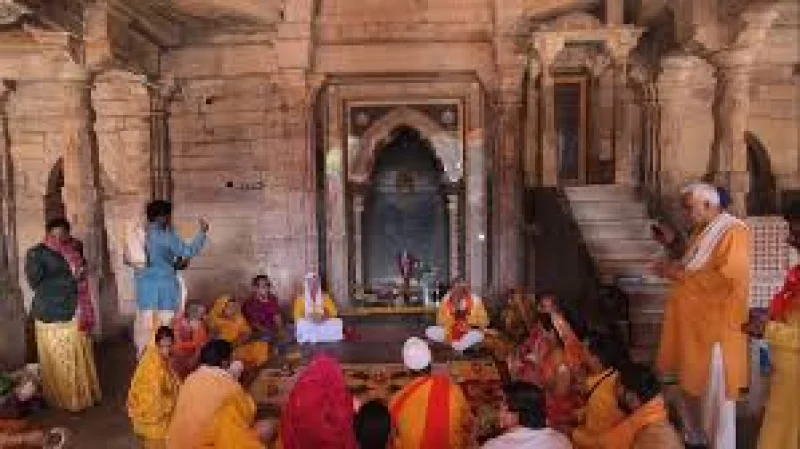
The Madhya Pradesh High Court ruled on Friday that the historic Kamal Maula mosque in Dhar is a temple dedicated to the Hindu goddess Vagdevi, a decision that immediately stripped away the fragile arrangement under which Hindus and Muslims had shared the site for years. By Sunday, the 13th-14th century monument was awash in saffron flags, Hindu worshippers had gathered in large numbers, and police were deployed around the Bhojshala complex, a protected monument of archaeological importance in central India.
For Mohammad Rafiq, 78, who has served as the mosque’s muezzin for 50 years, the ruling turned a place of prayer into a loss measured in a single day. “Until last Friday, our mosque was ours; today it is not,” he said. “I had never imagined in my dreams that something like this would happen.”
The case had been working its way through the Madhya Pradesh High Court after a petition argued that a temple predated the mosque at the site. The court dismissed the Muslim community’s petitions and said the site belonged to Vagdevi, also known as the Goddess of Speech, relying heavily on a survey of the monument carried out by the Archaeological Survey of India two years ago. It also allowed Muslims to seek an alternative piece of land in the district to build a mosque.
That ruling closes a long-running access agreement that dated to 2003, when the Archaeological Survey of India allowed Hindus to visit the site every Tuesday and Muslims to offer prayers on Fridays. The Bhojshala complex has been disputed for decades, with the earliest Hindu nationalist claims made in the late 1950s. Rafiq said his grandfather, Hafiz Naziruddin, led prayers there before India gained independence from British colonial rule in 1947, a reminder of how deeply the site’s religious life predates the current dispute.
On Sunday, local activists installed a temporary idol of the goddess as crowds gathered under heavy police presence, underscoring how quickly a court ruling can reshape the meaning of a monument that both communities had been forced to share. Muslim groups have pledged to challenge the decision in the Supreme Court, setting up a new legal fight over a site that the court has now redefined in the language of Hindu worship. Audrey Truschke, a historian of South Asia, said in response to such disputes that scholars look for “methodology, rigour, and conclusions that meet international scholarly standards,” while warning that “politically-motivated and substandard surveys carry little weight.” She added that “the current trend of targeting mosques in India is part of the entrenched Islamophobia of Hindu nationalism” and that it is “one of many ways for Hindu nationalists to harass, threaten, and harm Muslim communities.”
For now, the immediate result is clear: the shared arrangement is over, the mosque has been declared a temple, and the fight over Kamal Maula Mosque is headed to India’s highest court.