


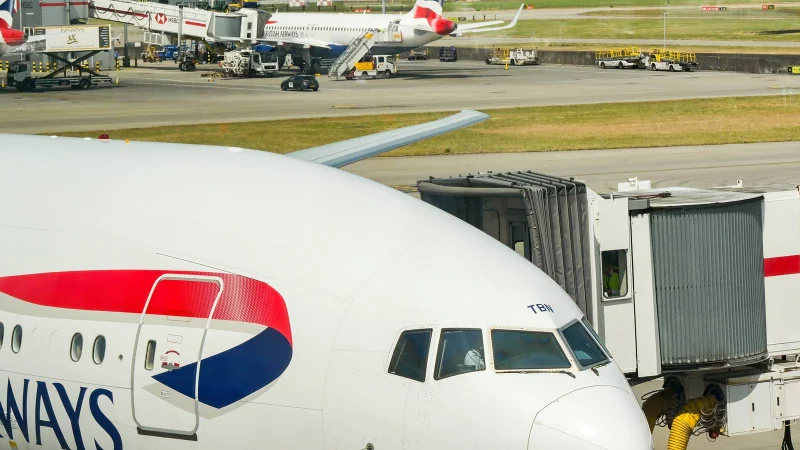
A British Airways flight bound for Washington was delayed more than six hours on Saturday after a flight attendant accidentally deployed an emergency slide on a Boeing 777-200ER while the aircraft was pushing back from the gate at London Heathrow Airport.
The incident happened at Gate B47 in Terminal 5 on Flight BA217, which was scheduled to leave for Washington Dulles International Airport. The aircraft’s Door 3L slide was triggered when the crew member reportedly heard the command “doors to automatic,” armed the door and then opened it, setting off the emergency system.
Emergency services attended the scene before the carrier replaced the deployed slide. The flight eventually left more than six hours behind schedule and arrived in Washington at around 21:30 EDT.
The delay mattered because the aircraft involved can seat up to 235 passengers, each of whom lost an evening or more of travel time. British Airways said it had apologised to customers for the delay and that its teams had worked hard to get them on their way as quickly as possible.
The cost of the mistake was also immediate. A source told The Sun that an accidental deployment is “a minimum £100,000 [$133,000] mistake,” and the repairs and inspection process can quickly add to that bill. Under UK261 rules, long-haul passengers are entitled to $690, or £520, for delays of over four hours.
British Airways has had an unusual cluster of inadvertent slide deployments in recent years, a streak that has made the airline’s procedures a point of attention inside the industry. One of the most high-profile cases came in 2023, when a flight attendant on their first day of work accidentally deployed a 777 slide before a Heathrow-to-Lagos flight. A similar incident followed in January 2025 onboard an Airbus A321.
That pattern matters because a deployed slide cannot simply be reset and sent back out. The airline has to remove it and inspect it before repacking or replacing it, a process that takes time and can turn a brief mistake into a long ground delay. After a series of similar events, the carrier introduced new procedures, but Saturday’s disruption showed how quickly a routine departure can still unravel at the gate.
For the passengers on BA217, the answer was not in the abstract risk of aviation errors but in a very real delay on a Saturday departure from Heathrow. The flight eventually made Washington that night, but the incident left another example of how one mistaken command can cost an airline time, money and a full load of travelers an entire day.
