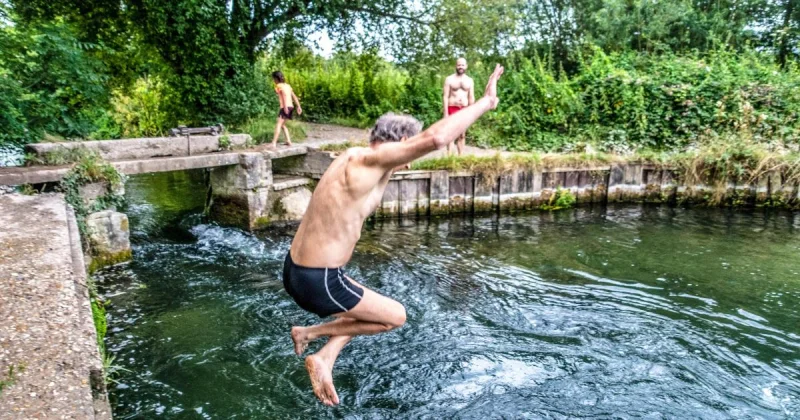
Margaret Dickinson and Philip Nice have mapped out Hampshire walks that end in a swim, or at least leave the option open. In their new book, Wild Swimming Walks Thames & West, the pair describe routes that thread through country parks, saltmarshes, city landmarks and riverside meadows, with secluded spots to get into the water along the way.
One of the most inviting stretches is the upper Hamble, which they say is a little reminiscent of the wooded rias of Devon and Cornwall. Secluded beaches there invite a high tide swim, while at River Hamble Country Park a floating jetty can be used to launch into deep water when the muddy banks are exposed. The council notices there merely advise against launching oneself from the jetty rather than banning it outright, a detail that says as much about local caution as it does about the appeal of the water.
The walk downriver turns into a lesson in Hampshire history as much as a route for swimmers. It passes through a sinuous causeway across the saltmarshes to a ferry that has been operating for 500 years, painted pink and still carrying people across the water. Hamble-le-Rice itself carries older echoes: in the 12th century, monks there were required to provide oysters in return for boots, bread and beer. The route also brushes past Hamble Manor Lodge, once owned by the Kray twins, before continuing after Hamble Common along Southampton Water, where a swim can be taken anywhere on the shingle beach.
From there, the walk reaches Royal Country Victoria Park in Netley, once the site of the largest military hospital in the world. The hospital had a psychiatric wing as early as 1870, and its own branch line; the last few yards of that line are now a miniature railway. Dickinson and Nice use these details to link the water’s edge with the layered past of the place, turning a swim route into a moving history of the coast.
Winchester brings another set of landmarks into view. The walk offers a glimpse of the Great Hall, best known for hosting the Round Table and restored by Henry VIII, before reaching the cathedral that was saved from subsidence into waterlogged ground by a diver working in the dark among putrefying bodies. Nearby, the Old Bishop’s Palace was the scene of the wedding breakfast of Bloody Mary, while Winchester College stands as the oldest in the country. At the Hospital of St Cross, the tradition is not swimming but hospitality: it still provides a Wayfarers Dole of ale and bread to anyone who asks.
The route then follows meadows that inspired Keats and hugs the limpid Itchen, or the parallel Navigation, for much of its length. That river is not without argument. Swimming in the Itchen remains controversial, with many anglers saying it scares fish away or damages a waterway. Yet bathing is already well established at Compton Lock, where Dickinson and Nice note a small but perfectly formed pool, and the route’s appeal lies partly in that balance between permission and restraint. It offers a Hampshire day out in which history, landscape and water never quite stop speaking to one another.
That is what gives the book its pull: these are not just walks with a view, but routes that end in places where a reader can imagine putting a foot in the water. The question is less whether the county has enough swimming spots than which of them will tempt walkers first, from the Hamble’s sheltered bends to the quieter reaches of the Itchen.
For readers following related local developments, the region’s cricket scene has its own Hampshire extension story, while nearby travel headlines have also kept New Hampshire in view. Here, though, Dickinson and Nice are focused on something slower and older: a landscape where a ferry still crosses, a pool still invites, and the past is never far from the bank.