


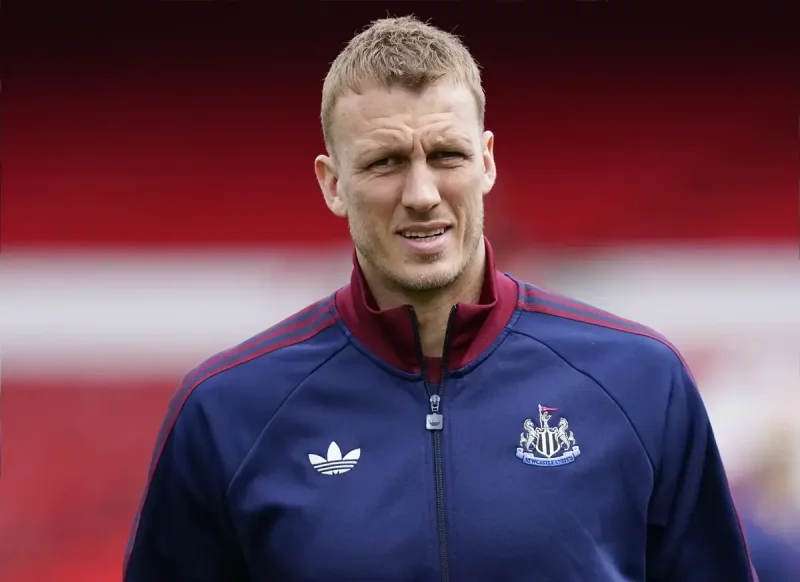
Dan Burn says a concussion in a Fulham match against Huddersfield Town sent him into a spiral of fear that he was dying and even made him persuade himself he had a brain tumour. The Newcastle United defender said he later went to Harley Street in London and spoke to neurosurgeons who told him: “No, you’re fine, there’s nothing wrong with you”.
Burn said the fear did not stop there. He could not sleep, had insomnia and was gripped by the idea that he was dying. In one stretch at Craven Cottage, he said he sat in his car holding the door handle, unable to move while he cried, before ringing his mother and telling her: “I don’t want to feel like this any more. When does it stop?”
The story lands in May 2026 with Burn, 6ft 7in tall, perched on a park bench in a Newcastle United tracksuit and looking out through the trees towards St James’ Park. The image carries weight because it comes from a player now described as a trophy winner with Newcastle and a grounded, late-blooming England international, but whose path was shaped by a stretch of anxiety that he says ran far deeper than football.
Burn said the roots went beyond one injury. He said his parents’ divorce probably affected him more than he realised, while Roz, then his girlfriend and now his wife, was working full-time and he was on his own for hours at a time. After games, he searched for his own name on social media, and even a single message such as “Dan Burn is s**t” hit him hard. Training, he said, became a refuge and gave him a few hours of respite, but the relief never lasted. Bad days, he said, quickly became bad weeks and then bad months.
That account adds another layer to a career that Burn has previously described as unorthodox, from non-league Darlington to the top level, after joining Premier League Fulham in 2011 at the age of 20. He said the steep rise left him with imposter syndrome, and the concussion episode turned that private doubt into something more acute and frightening. The bench in Leazes Park is one of 11 dotted across Tyneside as part of a joint initiative, and two policewomen even stopped him there for a selfie, which he happily gave them.
What makes Burn’s account stand out is the clash between the public image and the private cost. By the time he was on that park bench in Newcastle, he had already become a familiar figure to supporters, but the memories he chose to share were not of medals or caps. They were of crying in a car, of sleepless nights, of fear that would not let go, and of a phone call home in which he asked for the suffering to stop.
