


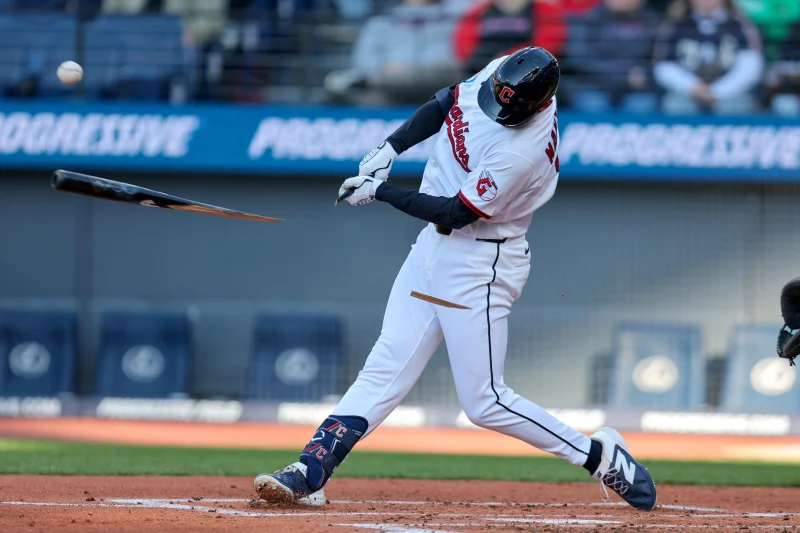
Kyle Manzardo’s first month of 2026 looked nothing like the hitter who put up 27 home runs, a.768 OPS and a 113 wRC+ in his first full major league season a year earlier. Through his first 28 games this season, he had one home run, a.512 OPS and a 50 wRC+, a start that left him buried near the bottom of the league’s performance tables.
The turnaround showed up in May. In 11 games, Manzardo matched his extra-base hit total from March and April with three extra-base hits and posted a.740 OPS and a 111 wRC+. The numbers point to a hitter who is not just getting better results, but doing it with cleaner plate decisions and more damaging contact.
That matters because the early-season slump was not simply bad luck in the usual sense. Through most of March and April, Manzardo was one of the unluckiest hitters in Major League Baseball by wOBA minus xwOBA difference, and as of now he remained the 19th most unlucky hitter in the sport by that measure. But luck alone does not explain how quickly the quality of his results changed in May.
Several of the underlying numbers moved sharply in the right direction. His chase rate fell from 29.7 in March and April to 26.8 in May. His zone swing percentage dropped from 66.8 to 61.9, while his in-zone contact rate jumped from 79 to 97.6. He also did far more damage when he made contact, with his hard-hit percentage climbing from 26.4 to 68, his barrel percentage rising from 7.5 to 20, and his average exit velocity increasing from 87.7 mph to 92.7 mph.
That is not a tiny swing in the margin. It is the difference between a hitter chasing enough to get himself out and a hitter who is making pitchers come into the zone, then punishing mistakes. Even his strikeout rate moved with the rest of the line, falling from 35.1 in March and April to 19.4 in May, while his walk rate rose from 8.2 to 11.1.
The most striking part is how little his mechanics appear to have changed. From March 26 through April 30 and again from May 1 through May 10, his stance and swing measurements were pretty much the same. That leaves the improvement looking less like a wholesale rebuild and more like a timing and decision-making reset that let the same swing play up.
For Manzardo, that distinction matters. Players who are early-season disappointments often get measured by the loudest number on the board, and in his case that number was ugly. But the May production suggests the bigger story may be hidden in the approach: fewer chases, better contact in the zone and harder contact when he gets his pitch.
Whether the improvement holds is the next question, but the evidence from May is enough to say the slump is not the whole story. Manzardo is still working out of a difficult start, yet the first signs of a real recovery are there, and they are showing up in the numbers that usually travel best from one month to the next.
