


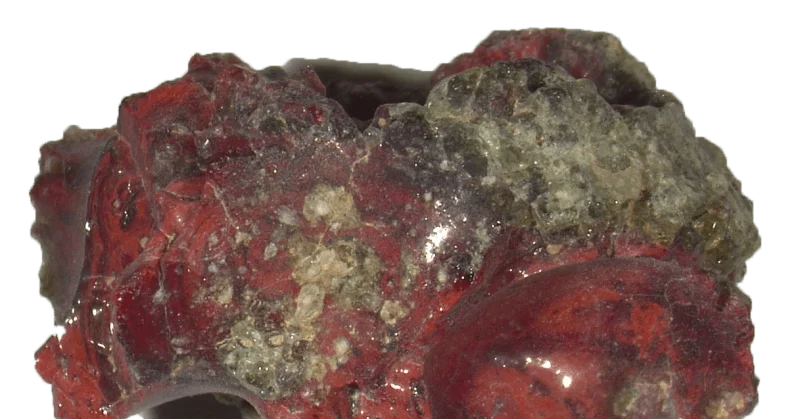
A material never before seen in nature or made in a laboratory was born in the New Mexico desert on July 16, 1945, when the Trinity nuclear test lit up the sky. An international research team has now identified the substance inside a tiny copper-rich metal droplet trapped in red trinitite, the glassy debris left by the blast.
The team, coordinated by Luca Bindi, says the material is a novel calcium-copper-silicon clathrate and that it formed spontaneously during the nuclear explosion. That makes it part of a tiny class of matter created under conditions so extreme that they cannot be matched by ordinary chemistry.
The Trinity shot is remembered as the world's very first test of an atomic bomb, and the new finding adds another layer to its scientific legacy. A few years earlier, Bindi's team had already documented a silicon-rich quasicrystal from the same detonation event, showing that the blast did not just destroy material in the desert; it also made rare forms of matter.
Researchers identified the clathrate using x-ray diffraction and other techniques after isolating it from the trinitite sample. Trinitite itself is a silicate glass that can contain unusual metallic phases, but the newly identified mineral stands out because it had never before been observed in nature or as an artificial compound created in a laboratory.
Clathrates are cage-like materials that trap other atoms and molecules inside their structure. They are of technological interest because they may help in thermoelectric materials, semiconductors, gas storage, and hydrogen energy technologies, which gives the Trinity discovery a relevance that reaches far beyond a museum specimen from 1945.
Bindi said the peculiarity of these materials lies in the nearly periodic arrangement of atoms, which can create unusual symmetries and physical properties that are very difficult to predict. That is part of why the finding matters: it shows that extreme temperatures and pressures can produce compounds that traditional methods may never yield.
The researchers describe nuclear explosions, lightning strikes, and meteoritic impacts as true natural laboratories, able to reveal forms of matter that are hard to reproduce in the lab. On the evidence from Trinity, that claim is no metaphor. The desert blast did not just end a test of a bomb; it also left behind a mineral that science is only now beginning to understand.
