


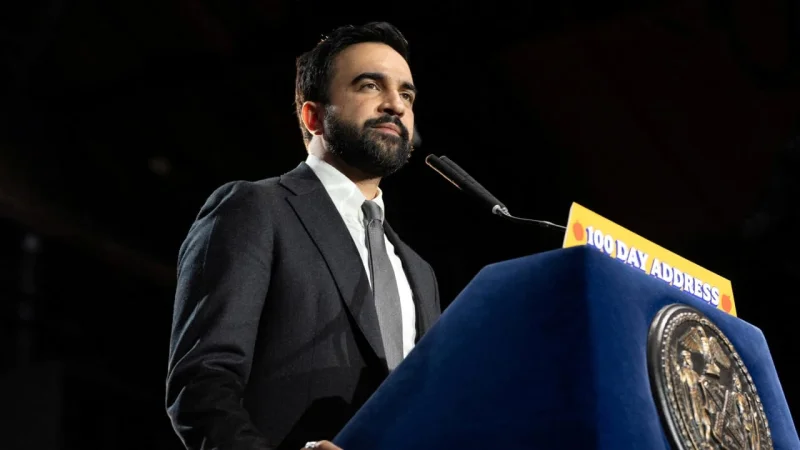
Zohran Mamdani marked Nakba Day on Friday with a social media post that included a video interview with a Palestinian New York resident identified as Inea. The post said Nakba Day commemorates the expulsion of more than 700,000 Palestinians between 1947 and 1949 during the creation of the State of Israel and the year that followed.
In the video, Inea described her family fleeing their home because of the Zionists coming into Jerusalem. The clip said the Hagana, Irgun and Lehi militias destroyed more than 400 Palestinian villages and cities and killed thousands of Palestinians, and said May 15 is the annual commemoration of the Nakba. It also argued that Palestinian displacement and the Nakba continue to this day.
The post paired that message with shots of Palestinian artistry inside Inea’s home, including a Visit Palestine poster created in 1936 by Frank Krausz, who was described in the video as a Holocaust survivor and a Zionist. That detail drew one of the most pointed responses online from Israeli activist Hen Mazzig, who said his own family fled North Africa and Iraq after the Farhud pogrom of 1941, six years before any war over Israel.

Mazzig accused Mamdani of weaponizing one trauma while erasing another, and took aim at the use of the poster. He said Palestinians were expelled during a war Arab states launched against Israel, that more than 850,000 Jews were driven from Arab lands and that almost none remain. He added that New York’s mayor should either stay out of the dispute or speak to both sides. Mamdani has not backed away from the broader political line that has defined his public profile on the issue. In 2021, he told a conference that he joined the Democratic Socialists of America because of his pro-Palestinian activism and said he was committed to socialist objectives and to the Boycott, Divestment and Sanctions strategy.
The episode lands at a moment when Mamdani’s position on the Israel-Palestinian conflict remains under intense scrutiny after his election in November. Post-election polls suggested that his support for Palestinian rights and anti-Israel stance drove 62% of his voters to the polls, and several members of his administrative staff are vocal anti-Israel activists. That backdrop has kept every new statement on the conflict under a microscope, including coverage that has also followed his orbit for reasons beyond the issue, such as the recent backlash over a penthouse video involving Rama Duwaji that prompted a separate story on his outreach to Ken Griffin.
For Mamdani, the fallout is unlikely to fade quickly. Nakba Day is not just another date on the calendar for his critics or supporters; it is now one more test of how far he will go in elevating Palestinian claims in public, and how sharply his opponents will push back when he does.
