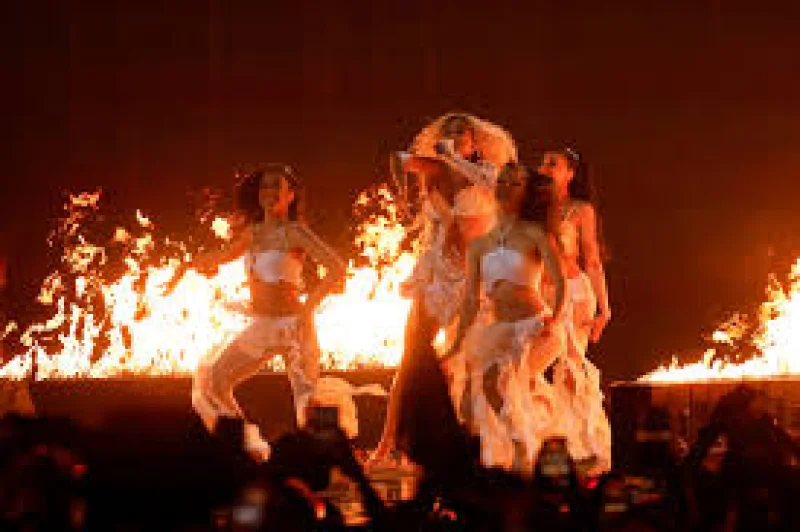
Antigoni Buxton will represent Cyprus with her dancefloor banger Jalla in the second semi-final, taking the Cyprus Eurovision 2026 bid into a night that could carry her through to Saturday's final. She hopes the dance-pop anthem will be enough to get her there.
For Buxton, the moment is the latest turn in a career that has already moved from reality television to the Eurovision stage. She appeared in series eight of Love Island in 2022, but said that was never the plan. “If anything doing Love Island was random,” she said. “Love Island was a great moment because it gave me the chance to introduce myself to a lot of people and now I'm on that path I always wanted to be on.”
Buxton, who was born in London and has Greek-Cypriot roots, said she had wanted to sing for as long as she could remember. “I've been wanting to be a singer, that has been my dream since I was as young as I can remember,” she said. Her fixation on Eurovision goes back to 2005, when Helena Paparizou won for Greece. “And I had an obsession with Eurovision ever since I saw Helena Paparizou win for Greece [in 2005],” she said.

The title of her entry carries its own meaning. Jalla is Greek-Cypriot slang that roughly translates as “more” or “again,” and Buxton said it is a word used only in Cyprus. “So it's a specific word that they only use in Cyprus,” she said. Her song also leans into the island’s sound, using traditional Greek instruments and referencing Tsifteteli, the popular belly dance.
That connection runs through the video as well. Buxton’s family, including her mother and grandparents, appear in the Jalla music video, a visible nod to the roots she said she carries across her work. “I am really proud to be able to share that, because sharing my roots is something I do across all my music,” she said.
Buxton said she spent six to eight weeks every summer in Cyprus while growing up and felt deeply connected to the country even while living in London. “I was born and raised in London but spent six to eight weeks every summer in Cyprus and grew up feeling very Cypriot,” she said. That personal link gives her Eurovision campaign a more grounded edge than a standard pop entry, even as it joins a contest where familiar faces are increasingly common. The question now is whether that mix of family, identity and a dancefloor hook can push Cyprus into the final.