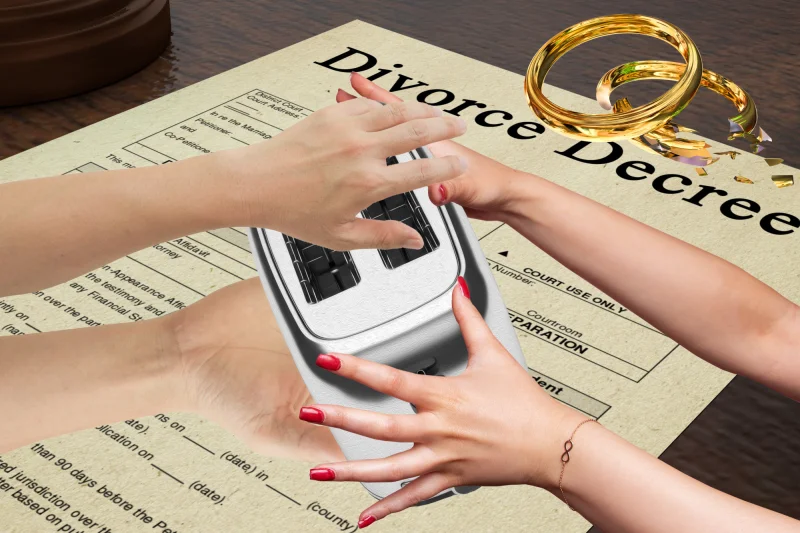
A $20 million divorce unraveled over a $49 toaster oven. In another case, a woman had a tanning bed moved from her marital home into her hotel room during the split. And one man tried to claim a couch because it was where his wife had caught him cheating with his mistress.
Those are the kinds of fights divorce attorney Paul Talbert says he sees most often: not over assets with obvious price tags, but over objects that have become loaded with meaning. “The most common fights I see are over stupid, inexpensive items,” Talbert said, adding that spouses will get into “knock-down, drag-out arguments over old mugs, pots and pans, cheap dining room tables, and couches worth next to nothing.”
The scale of the breakup problem helps explain why the smallest things can swell into the biggest battles. More than 1.8 million people split in 2023 alone, and attorneys say many of those cases are less about the item itself than what it represents to the person fighting for it. James Sexton put it bluntly: “It’s not about the pasta.” Then he said it again in a different way: “It’s very often not about pasta.”
Sexton’s point is that divorce settlements often turn on “the thing under the thing.” That can mean a wooden spoon a client believed was a family heirloom and that no one actually used, as attorney Sarah Jacobs recalled, or even a half-full bottle of dish soap under the kitchen sink, which Nicole Sodoma said once became part of a debate. “At one point, we were debating the value of a half-full bottle of dish soap that was left under the kitchen sink,” Sodoma said. She added that, in these fights, “it’s not about the object — it’s about what it represents, or the outsized importance it takes on when your sense of fairness is being challenged.”
The same instinct shows up in more expensive but still deeply personal items. Attorneys described clients fighting to retain access to private jet memberships, airline points and country club bonds, and Sexton said some settlements even include a provision that one spouse cannot go to a certain restaurant again. “I don’t want to see you there if I still go,” he said. That is the friction point in so many divorces: people are not just dividing property, they are trying to draw boundaries, keep dignity intact and settle a score that the market value of the object cannot explain.
That is why the cheapest item in the room can become the most important one. In divorce court, the question is rarely whether a toaster oven or couch is worth the fight on paper. The real issue is whether one more argument over a meaningless object is the last place a marriage still has power.