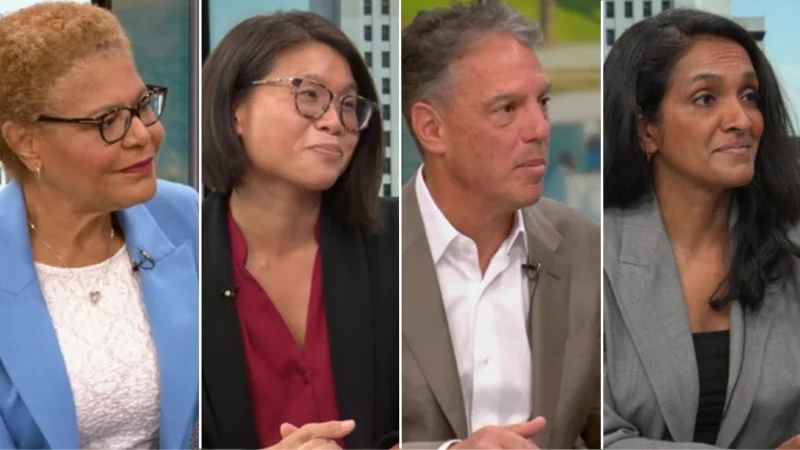
Los Angeles mayoral candidates Karen Bass, Rae Chen Huang and Adam Miller used a round of one-on-one interviews this week to sharpen their final pitch to voters before the June 2 primary election. The exchanges, conducted by ABC7's Josh Haskell, offered a clear contrast in style and priorities as Angelenos prepare to choose the city's next mayor.
Bass, running for reelection, leaned on the record she says her administration has built on homelessness and public safety. She said homelessness is down 17.5% two years in a row, calling it the first time the city has seen a decline in street homelessness. She also said homelessness has risen 18% nationally, and pointed to a homicide rate she described as a 60-year low. Still, Bass said the work is far from finished, noting that about 40% of people who have participated in Inside Safe have returned to the street while 60% have remained housed. She said Los Angeles needs a more cost-effective system to support people after they get off the street.
Inside Safe is the mayor's homelessness program, and Bass framed it as evidence that the city needs to do more than move people indoors. She said the real gap is what happens next, arguing that services are still lacking once people are off the sidewalk. That argument matters in a race where housing, homelessness and public safety have dominated the campaign, and where Bass is asking voters to extend her term based on results she says are already visible.

Huang, the deputy director of Housing Now California, cast herself as the candidate most willing to break with the city's current approach. Housing Now California is a coalition of more than 150 organizations that fights tenant displacement, and Huang said housing should be treated as a human right. If elected, she would become Los Angeles' first Asian-American mayor. She also said she would fire LAPD Chief Jim McDonnell and expand crisis response services instead of sending only police officers to an incident. Huang said too much of the city budget goes to LAPD, and argued that housing must be made accessible for most residents because many people cannot stay stably housed.
Miller, a nonprofit executive and entrepreneur who describes himself as a lifelong Democrat with working-class roots, said his case rests on efficiency and discipline. He argued that the city is wasting a lot of money and wasting an inordinate amount of time, and said he has spent decades doing budget and resource optimization. Miller, one of the candidates who has never held elective office, also tried to connect with voters' frustration by bringing up Spencer Pratt, saying he should have sympathy because he lost his home. Miller said Pratt's anger is understandable, but argued that anger alone is not enough and that voters should look for results.
The contrast in the race is now less about broad promises than about what each candidate thinks Los Angeles can actually deliver next. Bass is asking for credit for a decline in homelessness and crime. Huang is pushing for a deeper overhaul of policing and housing policy. Miller is selling himself as the outsider who can make City Hall work faster and spend less. With the primary days away, the question is not whether homelessness and public safety will decide the race. It is which candidate can convince voters that their fix will work in a city that has heard plenty of pledges before.