


FanDuel published its home run prop picks for Friday, May 15, 2026, and the board leaned on three hitters with clear matchup edges: Gunnar Henderson, Ketel Marte and Rafael Devers. The numbers behind the recommendations pointed to vulnerable pitchers, favorable batted-ball profiles and, in one case, a park that can turn ordinary contact into a long ball.
Henderson drew the first recommendation because of a matchup with Zack Littell and the Washington Nationals. Littell entered the 2026 campaign with a 5.49 SIERA and a 10.1% strikeout rate, and he had allowed 3.47 home runs per nine innings. Washington’s bullpen added to the appeal by ranking third-worst in reliever xFIP, a combination that left little margin for error if Littell could not work deep into the game.
Henderson’s own profile gave the pick some lift. He had a.285 wOBA this season and a career-worst 28.8% strikeout rate, but he also carried a 41.9% fly-ball rate against right-handed pitchers this year. In home run betting, that kind of lift matters because one well-struck ball can beat the rest of the line. FanDuel’s board was built on that simple idea: power plus a pitcher who had not shown the strikeout stuff to consistently escape trouble.
Marte was the next featured play, and the setting at Coors against Kyle Freeland mattered as much as the player. Marte had posted a.377 wOBA against left-handed pitchers in 2025, and this year he carried a.285 wOBA with an expected wOBA of.345. He also owned a career-best 43.8% hard-hit rate, which helped explain why his raw production and underlying quality could point in different directions but still land on the same home run answer.
Freeland, meanwhile, was not a total punching bag. Early in 2026, he had an 11.5% swinging-strike rate and a 3.89 SIERA, but the longer view was less flattering. From 2023 to 2025, he posted a 4.73 SIERA and a 16.2% strikeout rate. That gap between the recent surface and the larger sample is the kind of thing bettors watch closely, especially in Denver, where contact can travel.
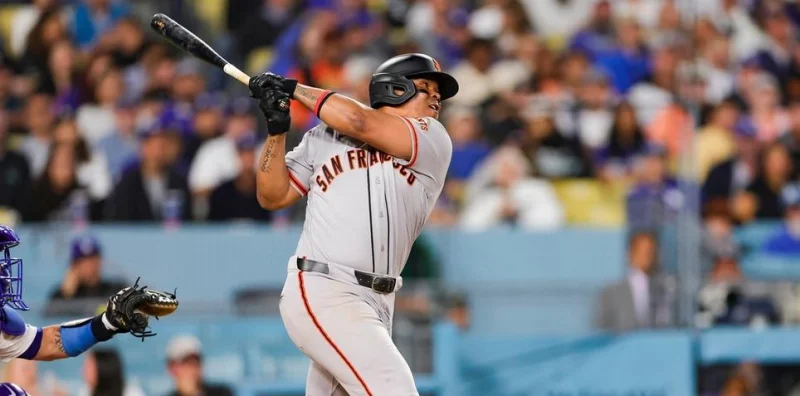
Devers was listed as the favorite home run pick in the San Francisco Giants’ game against the A’s, and the case rested on both consistency and context. He had a.300 wOBA this year after posting a.364 mark in 2024 and a.365 mark in 2025. The current season numbers were down, but his recent track record still showed a hitter capable of producing impact contact over long stretches.
The game at Sutter Health Park also brought Tyler Mahle and Aaron Civale into the frame. Civale carried a 4.54 SIERA and a 7.7% swinging-strike rate, and he had allowed a.375 wOBA at home this year. Left-handed hitters had produced a.350 wOBA and a 44.7% fly-ball rate against him, another split that made the matchup attractive for power hunting.
The betting notes also spelled out how the market works. A +210 home run line would return $210 in profit on a $100 bet if the player homered, and FanDuel said the wager would not be voided if the player recorded at least one at-bat, even as a pinch hitter. The company also said home run props can be parlayed as a standard parlay or as part of a Same Game Parlay, giving bettors more ways to package the same underlying read.
The larger story is not just which names appeared on the board. It is that the picks were driven by the same things that have made home run props move for years: pitcher weakness, hitter lift, and ballparks that punish mistakes. FanDuel said its stats came from FanGraphs and Baseball Savant unless noted otherwise, which is the backbone behind the pricing and the reasoning. For Friday’s slate, the edge centered on Henderson, Marte and Devers because the matchup data pointed to power before anything else.
Ben Rice was not among the three featured home run picks in the published board, but he sits in the same betting conversation whenever prop markets open and power metrics do the talking. On a day built around matchup analysis and long-ball odds, that is the company these numbers kept.
