


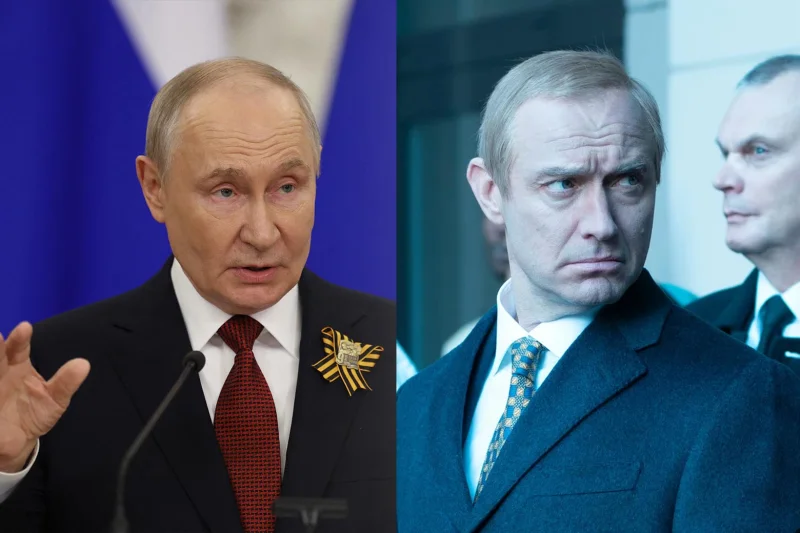
Olivier Assayas’ The Wizard Of The Kremlin follows Vladimir Putin’s rise and consolidation of power through the eyes of his chief special adviser, a character based on Vladislav Surkov, the political operator once known as the Russian leader’s gray cardinal. The film, adapted from Giuliano da Empoli’s novel of the same name, puts Surkov’s brand of power politics at the center of the story, where image, loyalty and manipulation matter as much as policy.
Assayas said the production drew a sharp line between the real Surkov and the fictional Vadim Baranov. “Cannot be mistaken for one another. Surkov is obnoxious; our Baranov, while complicit in the worst actions of the regime and somewhat perverse, retains a certain humanity,” he said. The director also said the film’s version of Boris Berezovsky is “as close to the truth as possible — and since he’s no longer alive, we can speak about him all the more freely.”
The project arrives with a built-in problem: it is a film based on a novel, not a biography, and the novel itself was described as factional. Assayas said that with other figures, the production remained under strict legal scrutiny and that some portrayals had to be softened to avoid the risk of defamation. He said his aim was “to stay as close to the facts as possible, even though we were adapting a novel that itself takes some, albeit measured, liberties.”
That tension matters because Surkov’s influence on Russian politics was not just personal, but ideological. He was widely seen as a key architect of Putin’s managed democracy, and his big innovation was fake news. As a former associate put it, “Nothing is true. There is no truth. There are alternative truths.” That line sits at the heart of the film’s subject matter and of the political method Surkov helped normalize.
The script reaches back to 1989, when Vadim enrolls in drama school in Moscow after the collapse of Communism. That detail mirrors the real Surkov, who did go to drama school in Moscow, was expelled for fighting and did not continue in theater. He later attended experimental productions in Russia and opera in the West, wrote lyrics for the rock band Agatha Christie, read voraciously and wanted to be a writer himself.
By 2009, Surkov had published his own dystopian novel, About Zero, about a ruthless gangster-publisher. The literary turn is one reason the film’s portrait of him lands as more than political biography: it is also a story about a man who understood narrative as a weapon. Surkov was known to like poetry, too, a detail that fits the film’s broader picture of a strategist who lived comfortably inside contradiction.
The film’s central argument is plain. Putin’s ascent is not portrayed as a straight line of events, but as something built through performance, persuasion and the careful manufacture of reality. By putting a Surkov-inspired adviser at the center of the frame, The Wizard Of The Kremlin suggests that the system around Putin was never only about force. It was also about teaching people not to trust the truth they could see.
