


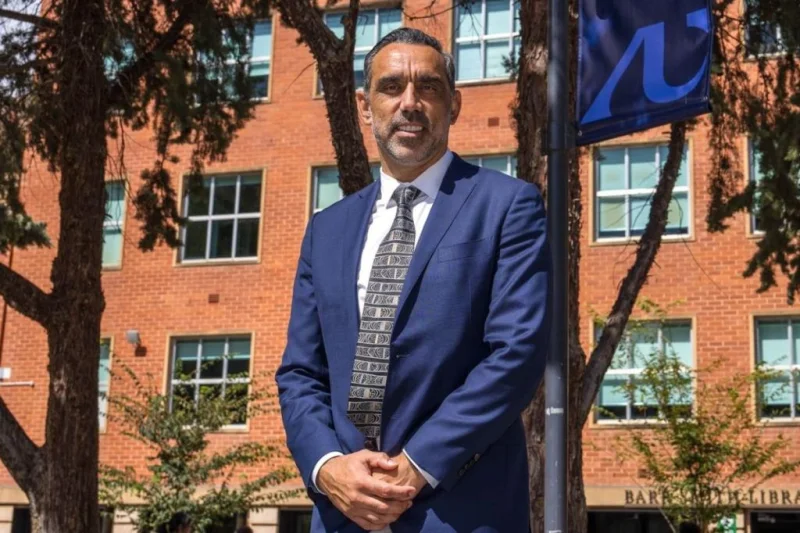
Adam Goodes has taken on the inaugural role of First Nations Ambassador at Adelaide University, placing one of Australia’s best-known Indigenous sports figures at the centre of a push to lift participation and retention for First Nations students.
Goodes said Indigenous Australians are “the most researched people in Australia” and said it would be “really great” if the university could create more PhD students and more Indigenous researchers. He said the aim should be to help produce “some of the biggest cohorts of First Nations people graduating from a university that the country’s seen”.
The former Sydney Swans champion, who retired from footy a decade ago after a 15-year career and won two Brownlow Medals, said he was taking the role because education has shaped his life. “Legacy to me is not something that I think about and breathe every day of my life, but education has been a key part of my life, and it’s helped and supported me,” he said. “I wouldn’t be in this position right now and accepting this role if education wasn’t something that I was passionate about.”
Goodes, who was born in Wallaroo and is an Adnyamathanha/Narungga man, will work with Indigenous leaders across different university portfolios and with Vice Chancellor Nicola Phillips. He and the university will also build a 10-year strategy to strengthen opportunities for First Nations students, with a focus on boosting participation and retention rates. No specific targets have been set yet.
The work lands at a university that is trying to define itself after a recent merger. Adelaide University is now the second largest employer in South Australia after the government, with about 12,000 staff. About 1.2 per cent of staff members are First Nations people, and the university had 752 First Nations students enrolled as of April 1.
Goodes said he wanted Adelaide University to become “the university of choice for First Nations Australians”, calling that “a real tick of approval” for the institution. But he said that would require change inside universities, “not only as institutions, but as it looks and feels on the ground for our people as well”.
The appointment also adds another chapter to a public life that has carried far beyond the football field. Goodes was named the 2014 Australian of the Year, has advocated for Indigenous education since retirement, and in 2023 was immortalised in a bronze sculpture at the player’s entrance of Sydney Swans HQ, depicting his war dance. His new role arrives as the university seeks to widen its reach with First Nations communities and make those ambitions visible in enrollment, staffing and graduation numbers.
That effort comes against a broader backdrop of debate around the university’s public symbols and presence. During the recent state election campaign, SA One Nation leader Cory Bernardi criticised Aboriginal flag signage at the university that included a Kaurna greeting, “Niina Marni,” meaning “hello, how are you?” For Goodes, the task now is less about ceremony than outcomes: more Indigenous researchers, more graduates and a stronger sense that First Nations students belong there from the start.
