


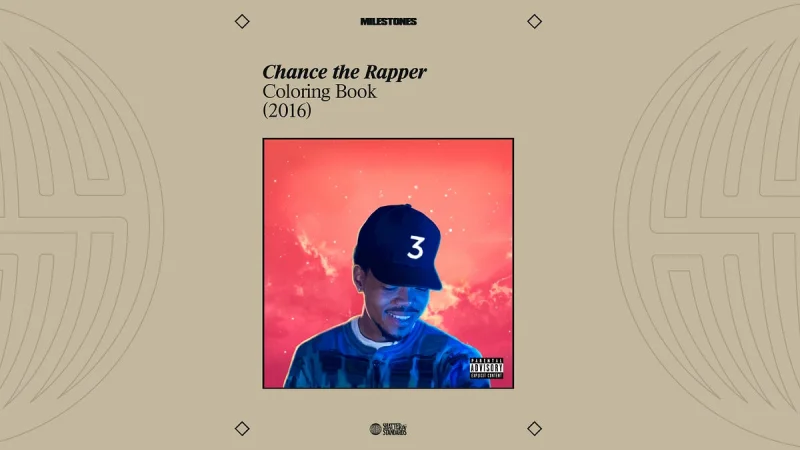
Chance the Rapper dropped a mixtape that could be heard but not bought, and a month later the music business changed the rules around him. In June 2016, the Recording Academy quietly amended its eligibility rules so streaming-only projects could compete for Grammys after Chance’s fourteen-song Coloring Book arrived on Apple Music and spread fast enough to make itself impossible to ignore.
The 23-year-old Chancelor Bennett had already built a following by moving outside the old system. He released 10 Day in 2012 and Acid Rap in 2013, then pushed further with Coloring Book, which reached number eight on the Billboard 200 on 57 million streams. The numbers mattered because they showed that a free mixtape could move like a major label album and force institutions to take notice.
Chance recorded most of Coloring Book at Chicago Recording Company in early 2016, turning the space into a temporary home as the project took shape. He rented one room, then another, and eventually took over the entire place. Air mattresses went into every room, and people lived there for weeks while he worked through the songs. The result was not a polished industry statement so much as a record built in public, with gospel, choir, and neighborhood memory woven through it.
That mix gave the project its force. Chance told Zane Lowe he was not trying to make new gospel or pretend to be the gospel. He said he was making “just music from a Christian man,” and the songs carried that idea in plain sight. He went through roughly twenty versions of Same Drugs before landing on the one that stuck, a Peter Pan story that ended up carrying one of his most quoted lines: “You were always perfect, and I was only practice.” He later called the dropped Regina Spektor collaboration his biggest mistake.
Other tracks widened the frame. Summer Friends reaches back to Harold’s Chicken, Blockbuster rentals, lightning bugs in the backyard on 79th, and South Side childhood memories. How Great opens with his cousin Nicole singing “How Great Is Our God” for three straight minutes. Kirk Franklin preaches on Finish Line/Drown, Jamila Woods appears on the first Blessings, and a Chicago children’s choir drives the hook of All We Got. The mixtape sounded local, but it traveled like a statement.
The tension was that Coloring Book arrived outside the old album machine and still made the industry bend around it. Chance had been dodging labels since 10 Day and blowing past them since Acid Rap, but this release made the rest of the music business rearrange the furniture. A free project on Apple Music was suddenly a Billboard force, a streaming phenomenon, and then, almost immediately, a test case for the Grammys.
What changed in June was not only the rulebook but the idea of what counted. Coloring Book did not ask permission to matter. It streamed, it charted, it won attention, and then the academy adjusted to catch up. For Chance, the question was answered by the numbers and the rewrite: the system had moved because his mixtape had already gone where the system had not.
