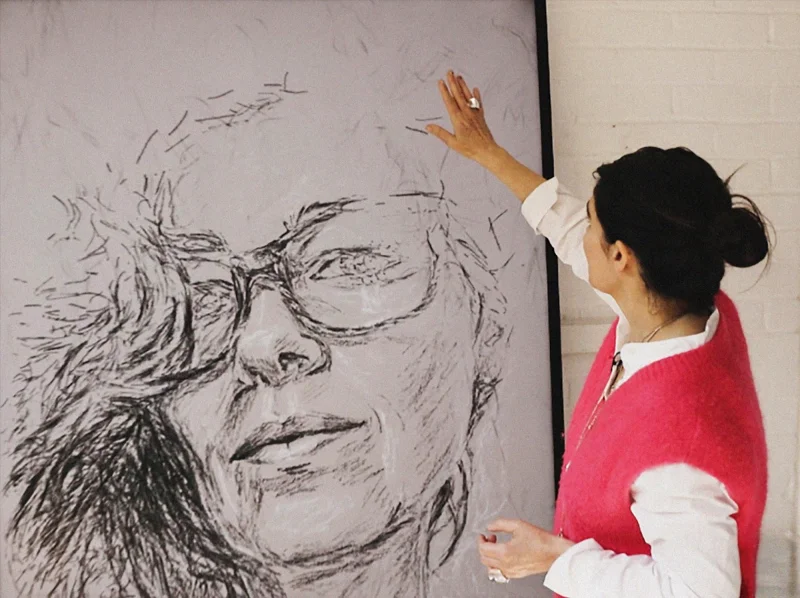
Es Devlin is asking people across the UK to become part of A National Portrait, a new participatory work that will open at the National Portrait Gallery on 14 May 2026. The project will run until 27 October 2026 and will be installed in the gallery’s History Makers space.
Anyone in the UK can upload a photograph of themselves through a dedicated online platform, and that image will be transformed into an animated digital portrait inspired by Devlin’s charcoal and chalk drawing practice. The result will not sit outside the work as a record of participation. It will be part of the artwork displayed inside the gallery, while each participant also receives a downloadable digital edition of their portrait.
The opening gives the project immediate public weight. On 14 May, the gallery will also host a free drawing event led by Devlin, while an online step-by-step drawing class will be available nationwide. Free Drop-In Drawing sessions will continue throughout the exhibition period, with workshops set for 12 June 2026, 3 July 2026, 4 September 2026 and 2 October 2026. The final session will be led by Devlin herself.
The project marks the end of three years of collaborative research between Devlin and Google Arts & Culture Lab. It also extends a partnership that Freya Salway described as decade-long, and one built around artist-led experimentation with advanced technologies. Dr Flavia Frigeri said the next six months will allow audiences “not only [to] observe but to become part of this portrait itself,” pushing the boundaries of portraiture.
That matters because the gallery is not treating participation as a side feature. It is making the public visible inside one of Britain’s best-known portrait collections, a collection described as the largest in the world and made up of more than 220,000 artworks. Devlin said the National Portrait Gallery belongs to everyone and called the collection a mirror of the country, reflecting who people have been and who they are becoming. Her aim is plain: to let the work keep redrawing itself as each new participant joins.
The tension is in the promise and the delivery. A project framed around shared identity could have settled for symbolism, but this one asks people to hand over an image of themselves and then places that image inside the institution rather than simply around it. It is a neat technological gesture, but also a political one, arriving at a time when conversations about national identity are increasingly divisive.
By the time A National Portrait closes on 27 October 2026, the question will not be whether the gallery staged another exhibition. It will be whether a portrait can still mean something broader than likeness, and whether the public will see themselves not just on the wall, but in the act of making the wall itself.