


A tornado warning was issued for Martin County until 7:45 p.m. Sunday as storms intensified across southern Minnesota, where the National Weather Service said a short rope tornado touched down for about a minute before lifting. The storm was still showing signs of rotation after the tornado lifted, and the area southwest of Mankato remained under close watch.
The warning came after several tornado warnings had already been issued near Mankato, including for areas around Truman, Lewiston and Northrop. By 3:30 p.m. Sunday, the weather service had also issued a tornado watch for Cottonwood and Jackson counties until 10 p.m., widening the alert area as the severe weather threat built through the afternoon.
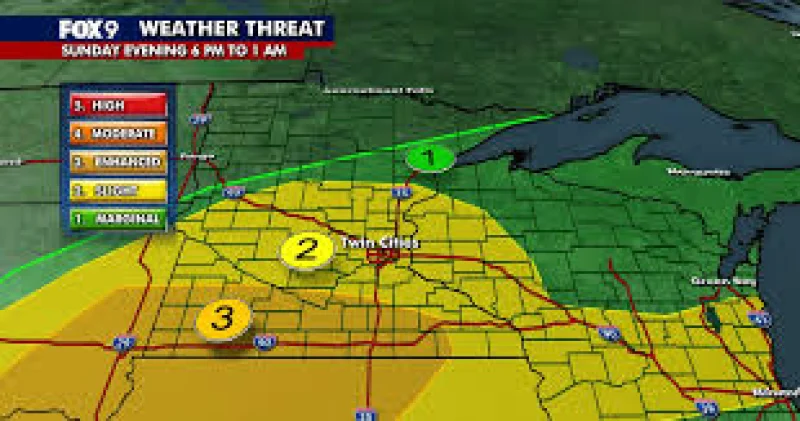
Forecasters said the setup was not about one isolated storm. Western, central and southern Minnesota were under a Level 2 slight risk for severe weather, while far southwestern Minnesota was at a Level 3 enhanced risk. Thunderstorms were expected to move into western and southern Minnesota around dinner time Sunday and then push east, with the first threat including large hail, strong winds, an isolated tornado and heavy rain.
Ian Leonard described the night ahead as a “bumpy night of severe weather in southern Minnesota,” and Jared Piepenburg said, “we should stay sky aware Sunday night.” The National Weather Service later extended a tornado watch until 1 a.m. Monday for portions of southern and southwestern Minnesota, though that watch did not include the Twin Cities metro.
For people searching tornado near me, the timing mattered as much as the geography. Strong to severe storms were expected to reach the Twin Cities metro sometime after 10 p.m., but forecasters said the system should clear out before the Monday morning commute. That meant the worst of the weather was expected Sunday night, when the focus remained on southern Minnesota and the communities already dealing with repeated warnings near Mankato.
The tension in this forecast was the difference between a short-lived tornado and the broader storm line around it. The rope tornado may have lasted only a minute, but the rotation did not disappear when it lifted, and that left the region exposed to more severe weather as the night moved on. Southern and southwestern Minnesota faced the highest immediate risk, while the metro waited farther east in the line.
By late Sunday night, the question was not whether the storms would arrive, but how strong they would be when they did. The weather service said the system should move through before dawn, but until then the path from Martin County toward the Twin Cities stayed active, shifting, and dangerous.