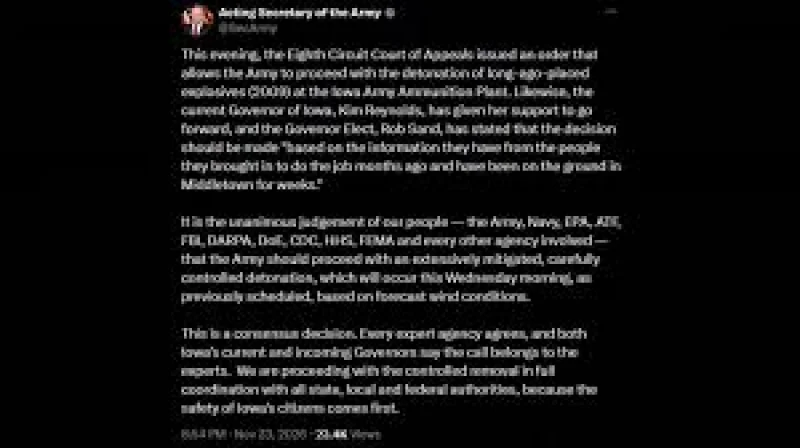
The U.S. Army said late Monday it will go ahead with a controlled removal of 68 barrels of lead azide in Iowa on Wednesday morning, after a federal appeals court cleared the emergency permit. The detonation is planned at a site near Middletown, where officials have been trying to manage a hazardous stockpile that has already pushed the calendar back three times.
The timing matters because the Army said the weather is most favorable on Wednesday, making that the best window for the operation after last Friday’s planned date slipped again and again amid public concern over health and environmental effects. The operation is being coordinated with state, local and federal authorities, and the state has set up a dedicated website while the state emergency management office remains activated.
In court, a three-judge panel of the 8th U.S. Circuit Court of Appeals said earlier Monday that the U.S. Environmental Protection Agency had adequately built safeguards into the emergency permit. The judges said the permit conditions addressed concerns raised by environmental groups that sued to stop the detonation, including barriers around the storage area, weather restrictions, advance public notification, updated air modeling, and environmental monitoring and sampling.

The panel also said the Army had evaluated a full range of alternatives, not just the two examples most people would picture first. In practical terms, that means the Army looked at methods other than blowing up the material in place, including chemical neutralization and thermal treatment, before settling on the controlled removal now set for Wednesday. The site sits not far from the Mississippi River, about 90 miles south of Cedar Rapids, which is part of why the dispute has drawn so much attention in Iowa.
The fight has not only been about safety. Trump said he wanted Gov.-elect Rob Sand to approve the detonation even though Sand has said the decision belongs to the Trump administration and the experts it brought in months ago. On Sunday, Sand said, “No good options exist and the situation is more dangerous and unpredictable than it ever should have been.”
Rachel Rintelmann said the ruling lets the Army move ahead, but she said the public still deserves more information and more protection. “Today, the 8th circuit decided to let the Army proceed with its plan, and we respect that decision,” she said. “But the Army created this emergency through neglect, and it owes the people of Iowa more information about the planned detonation and more safeguards for their health.”
The Army had initially planned the detonation for last Friday, then changed the date three times after the backlash grew. Environmentalists sued last week to stop the detonation, and the court briefly halted the permit before the Army argued it did not need authorization because the situation was an emergency. That leaves Wednesday morning as the first real test of whether the permit conditions, the weather and the monitoring plan can hold together under pressure.