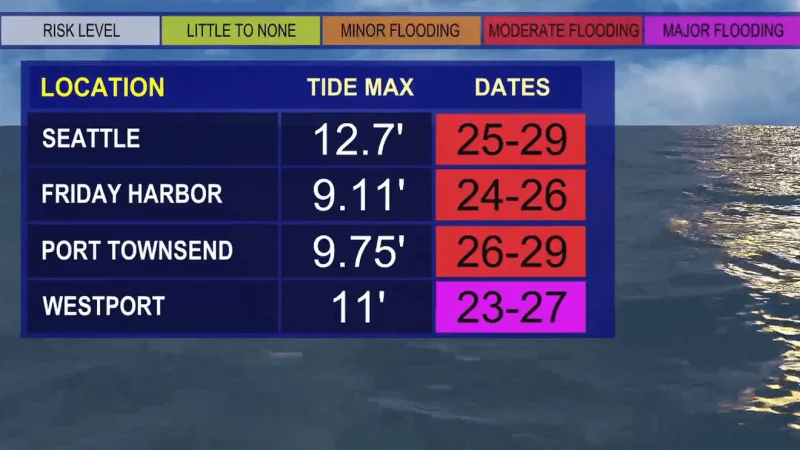
Coastal flooding is becoming a concern in Western Washington this Thanksgiving week as king tides line up with two storms. The risk is highest from Grays Harbor south toward Willapa Bay, where Monday and Tuesday are being watched for significant flooding on the ocean beaches.
George Waldenberger said, “King tide season is here.” That warning matters because king tides are the highest predicted high tides of the year, and this week’s setup gives them extra help from heavy rain and strong coastal weather. People in Westport, Ocean Shores and the Long Beach Peninsula are among those most exposed first, with the focus then shifting to Wednesday and Thanksgiving Day in the Puget Sound region.
The timing is what makes this week different. King tides often arrive when a new or full moon lines up with the Moon’s closest point to Earth, and a supermoon is associated with the pattern now. The Moon’s pull is stronger when it is closer, which raises the tidal range and lifts the highs. The Sun also lends a hand near the solstices, and late fall and winter are a season for especially high tides along the West Coast.
Even so, the forecast is not a straight replay of a worst-case flood event. The strongest low is expected to stay offshore, which should limit the most severe impacts, but it does not erase the concern. On the outer coast, low pressure and large waves can still worsen flooding all week, while heavy rain on Wednesday and Thanksgiving Day could add runoff and high tides could slow drainage in low-lying areas.
The picture is also different from December 2022, when the Duwamish River overtopped its banks and flooded South Park. This week’s concern is more distributed: the beaches first, then the inland waters of the Puget Sound region, with the king tides expected to tone down early next week. For now, the question is not whether the water rises, but how far it reaches before the tide cycle eases.
Background conditions are adding to the concern. Super El Niño and any El Niño-related Kelvin wave activity can raise water levels, which helps explain why forecasters are watching this stretch so closely. The next period that matters most is the holiday window itself, when rain, tides and drainage problems can stack on top of one another in the areas already most exposed.