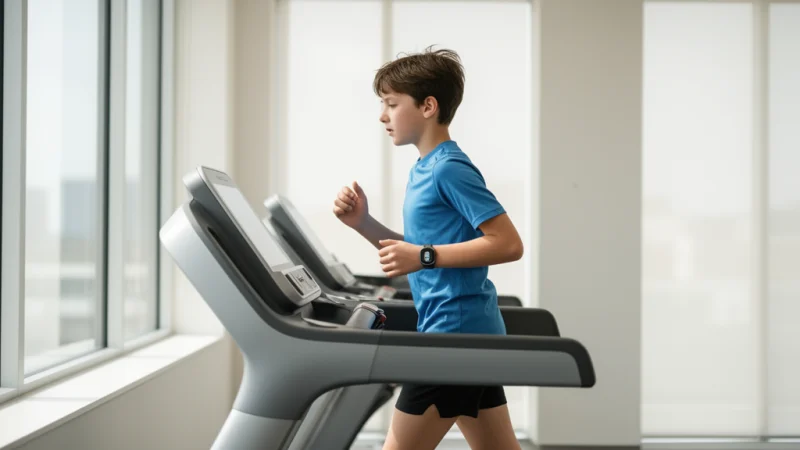
A pooled analysis of eleven intervention studies found that structured exercise programs were associated with statistically significant pre-to-post gains in Hrv measures among children and adolescents with overweight or obesity. The review, led by Kaiyang Wu, reported higher high-frequency power, pNN50, SDNN and RMSSD, along with a lower low-frequency to high-frequency ratio.
The study was published in Frontiers in Public Health after searches of PubMed, Embase and Web of Science turned up eligible intervention work in participants aged 6 to 18 years. The quantitative synthesis used standardized mean change scores, Hedges’ g and random-effects DerSimonian-Laird models with 95 percent confidence intervals, and the protocol was registered in PROSPERO under CRD420251102937.

That result matters because Hrv is a window into cardiac autonomic regulation, and youth with obesity are often described as having impaired balance between vagal and sympathetic activity. The review adds to a field that has been trying to understand whether exercise can shift that balance early enough to matter, when habits and physiology are still changing.
But the finding stops short of proving that exercise alone caused the improvement. The authors said the gains came from single-group pre-post comparisons, so maturation, dietary changes or other time-dependent factors could have played a part. That leaves the size of the changes, and whether they are clinically meaningful, as the question that still hangs over the pooled numbers.
What the analysis does show is a signal, not a verdict: in youth with overweight or obesity, planned exercise was linked to better Hrv after intervention, but the design cannot separate training from the rest of life moving forward at the same time. For clinicians and families looking for a practical takeaway, the message is narrower than a blanket promise, but stronger than speculation — exercise is associated with measurable autonomic shifts, even if the review cannot say how much of that shift belongs to exercise alone.