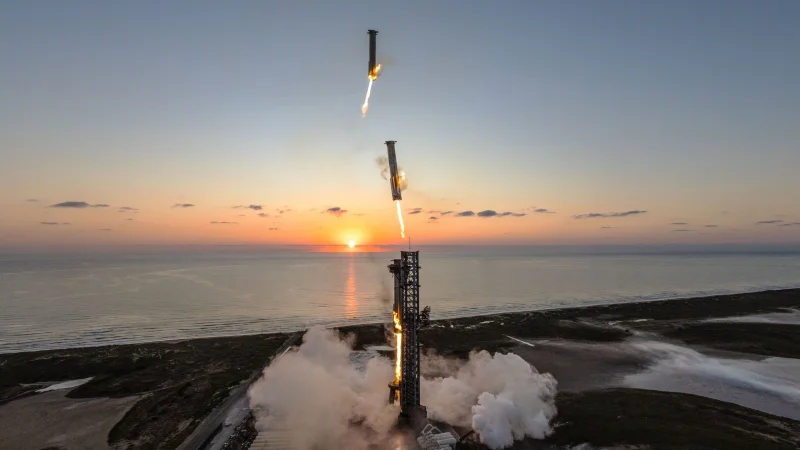
SpaceX is set to launch Starship Flight 15 on Friday at 5:45 p.m. ET from Starbase in Cameron County, Texas, and it will try something the latest version of its booster has not yet done: come back to the pad and be caught by the launch tower. The company has 75 minutes to get the rocket off the ground before it has to scrub the attempt.
The flight is the 15th time SpaceX has lined up Starship, the 407-foot-tall rocket and spacecraft it wants to turn into a fully reusable system. About six minutes after liftoff, the first-stage Super Heavy booster is expected to return to the launch site for the tower's mechanical arms to try to grab it. If that works, it would mark the first catch of the latest booster version, even though SpaceX has already caught a previous generation booster three times.
The mission itself is built to show how much the company can do in one long run. Starship is expected to orbit Earth about 14 times during a more than 22-hour flight and deploy 26 Starlink V3 satellites. That combination of launch, recovery and payload delivery is what makes this test matter now, because the company is not just trying to send hardware up and down again. It is trying to prove that it can do it quickly enough to change the economics of launch.

Elon Musk has long framed that idea in simple terms: if a car had to be thrown away after every trip, nobody would call it normal. Casey Dreier of The Planetary Society put the cost side more plainly, saying the cheap part of a launch is the fuel. He said catching the rocket is a critical step toward reusability and rapid reusability, and that launches would need to turn around within a couple of days, if not a day, to match that goal.
That is where the promise runs into the proof problem. SpaceX has shown it can catch a booster before, but only with the previous generation. The latest version is the one now under pressure, and the difference matters because the company is trying to move from a one-off stunt to a repeatable system. Austin Spiegel captured the challenge another way, calling rocket recovery like trying to land a toothpick in a hurricane. The point is not the drama of the catch itself. It is whether the same rocket can come back, be used again and keep the pace fast enough to matter.
If Friday's attempt works, SpaceX will have taken a step closer to the kind of launch system it says it wants: one that can be recovered, refueled and sent back up without long delays. If it does not, the question will shift to how much more work the latest booster needs before the company's quickest path to cheaper and faster missions becomes real.