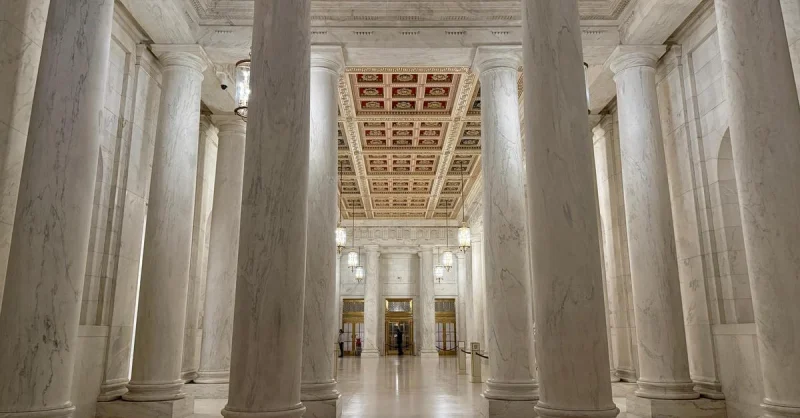
The Supreme Court will hear argument on Monday, Nov. 9, in a case that could decide whether a federal detainee may seek damages from a law enforcement official for alleged constitutional violations. Kekai Watanabe says a prison paramedic failed to treat him after he was injured in a fight while in federal custody, leaving the justices to revisit how far a damages remedy against federal officials can reach.
The case matters now because it lands before a court that has repeatedly pulled back from Bivens remedies. Watanabe contends that Francis Nielsen violated his rights under the Eighth Amendment when he was badly injured during a gang-related fight at a federal detention center in Hawaii. He says he told Nielsen his pain was a 10 on a scale of 1 to 10, but received only over-the-counter pain medication. He also says he remained in solitary confinement for more than two months without seeing a specialist or going to a hospital.
Watanabe's lawsuit turns on a narrow but powerful question: whether his medical-care claim fits within the small set of cases the Supreme Court has already allowed under Bivens v. Six Unknown Named Agents of Federal Bureau of Narcotics, or whether it is a new context that cannot go forward. In February 2022, Watanabe went to federal court in Honolulu and relied on Bivens and Carlson v. Green, arguing that Nielsen was deliberately indifferent to his serious medical needs. The dispute now sits at the center of a doctrine that began more than 50 years ago and has been narrowed ever since.

That narrowing is where the fight has sharpened. In Carlson, the court allowed an inmate's estate to sue after prison officials failed to provide adequate medical care for eight hours following an asthma attack. Here, the district court said Carlson did not apply because Watanabe's claim arose in a new context. The U.S. Court of Appeals for the 9th Circuit took the opposite view, saying Watanabe's claim is identical to Carlson in all meaningful respects. Nielsen wants the justices to shut the case down entirely, and the Trump administration has backed him with a friend-of-the-court brief.
Justice Clarence Thomas has signaled how skeptical the court has become. In Egbert v. Boule, he wrote that in all but the most unusual circumstances, creating a cause of action is a job for Congress, not the courts, and that if the court were asked to decide Bivens today, it would decline to infer any implied causes of action in the Constitution. Egbert also noted that the court had declined 11 times to imply a similar remedy for other alleged constitutional violations. That leaves Watanabe's case at a crossroads: preserve the remaining medical-care remedy recognized in Carlson, or use it to close the door on damages claims against federal officials altogether.
When the justices hear argument Monday, they will not just be weighing one detainee's account of a fractured coccyx, seven months after an injury, and pain that Watanabe says never stopped. They will be deciding whether Carlson still has real force or whether Bivens has reached the end of the line.