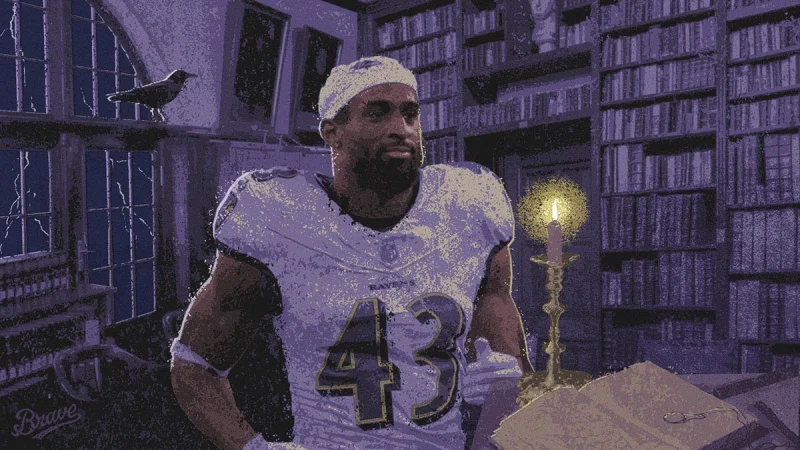
Justice Hill says the worst stretch of his career became the one that changed him most. The Baltimore Ravens running back said his Achilles tear on Sept. 2, 2021, forced him to move from what he calls "Pre-Achilles Justice Hill" to "Post-Achilles Justice Hill," a shift he says rebuilt his mentality as much as his body.
That matters now because Hill is in Year 8 with the Baltimore Ravens, a veteran on a team that still carries Super Bowl aspirations. He has spent his entire NFL career in Baltimore, and at this stage he is no longer talking like a player trying to make it through camp. He is talking like someone who has already survived the part that can break a career.
Hill said he needed that lesson in ways he did not understand at the time. "Sometimes, you’ve got to go through adversity to build yourself, build your character, build your mental," he said. "At the time, it sucks. But when I look back? I needed that." For a player who will turn 29 in two weeks, that is not just reflection. It is the logic that explains why he sounds so certain now.

The certainty was not there before the injury. Five days before he tore the Achilles, Hill was already dealing with a high ankle sprain and expected to watch the final exhibition game against Washington from the sideline. Instead, he heard John Harbaugh tell him there was no room for him on the roster and that he would be cut. Then J.K. Dobbins tore his left ACL nine plays into the game, and Harbaugh came back with a different message: "This is going to be your year."
Hill said that kind of turn left him unable to trust what he was hearing. "It was so much to battle through because it’s like, ‘OK, everybody in the building does not want you here,’" he said. "You don’t know how to feel. I hear you, but I don’t hear you because you said something different five minutes ago." He also said Greg Roman once told him the team wanted to sign a running back to replace him. The message, Hill said, was clear enough to poison his focus even when opportunity was sitting in front of him.
"You’re internally pissed," Hill said of that period. "You have an opportunity, but you’re so caught up in all the other stuff that you can’t even focus on it. So that led to the injury because my mental wasn’t in the right space." That is the part that gives his story its edge: the injury was not only physical. It became the end of one version of him and the start of another.
Hill says he came out of rehab with a different mindset, one built on survival instead of uncertainty. "I don’t care who wants me here or not," he said. For the 2026 Baltimore Ravens, that kind of veteran edge is part of why he still matters. For Hill, the next question is not whether he belongs. It is how far the player who came out of that wreckage can still carry himself, and the team, from here.