Emily Mae Smith is asking viewers to look at her work differently. As her New York exhibition opens, she says her painting belongs more to fin-de-siècle Symbolism, the Nabis and related movements than to Surrealism, a reading that has long shadowed her practice.
The timing matters because the keyword search around Worlds 2026 is not just about a title; it reflects the way Smith’s current comments land beside a fresh exhibition moment. Her auction record still stands at around $1.6 million, and her market history remains tied to a run-up that made her one of the names collectors watched closely even as prices later cooled.
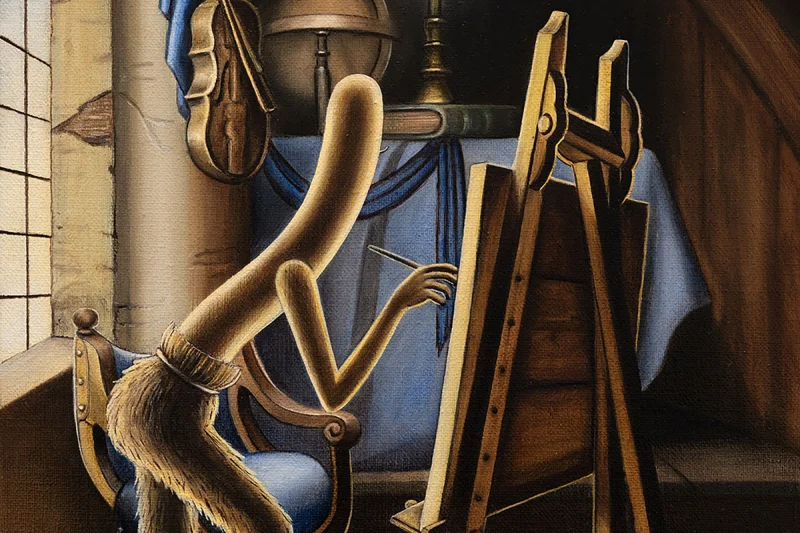
At the center of that argument is Sacred Conversations, which Smith says plays with several historical genres at once. She describes it as gathering animals, plants and artists’ tools inside a shallow architectural niche, with small jars of pigment lining a lower shelf beneath the carved word EMSKITH. The image began, she said, as a portrait-like vanitas of her own studio environment, which is part of why she sees the work as rooted in Symbolist and Nabis traditions rather than in the dream logic usually attached to Surrealism.

Smith’s reasoning turns on material and method. Looking closely at her brushes led her to think of them not as abstract instruments but as objects made from sable, badger and squirrel. “I was pulling out my paintbrushes and looking at them: this one is sable, this one is badger, this one is squirrel. Beyond being a tool, the tool is made from something in the world,” she said. That emphasis on the crafted object, the thing in hand and the image as a constructed surface, pushes her work toward Symbolist and Nabis concerns with symbolism, atmosphere and the made thing itself.
That is where the friction sits. Smith has often been linked to Surrealism, especially after her 2024 exhibition at the Magritte Museum in Brussels paired her work with masterpieces by Magritte, but she says that reading misses what she is actually doing. The distinction is not cosmetic. Surrealism leans toward the uncanny as a break from ordinary reality, while her description of Sacred Conversations points to a more deliberate layering of signs, tools and ritual objects, closer to the fin-de-siècle worlds she names.
Her market history makes the shift more than an academic correction. Broom Life fetched HK$12.35 million at Phillips Hong Kong in June 2021 against a HKD400,000-600,000 estimate, a result that helped define the surge around her name. The broader post-pandemic ultra-contemporary boom and renewed interest in Surrealism fed that rise, but prices have since readjusted significantly even as the auction record remains intact. For viewers coming to the new show now, the point is not simply what Smith has sold for. It is how she wants the work read before the doors open at Petzel in New York.
That makes the next viewing more consequential than a routine gallery stop. If Smith’s own framing holds, Sacred Conversations and the rest of the exhibition will ask visitors to see her paintings less as Surrealist puzzles than as images built from Symbolist inheritance, Nabis design and the stubborn material facts of paint, brush and pigment.