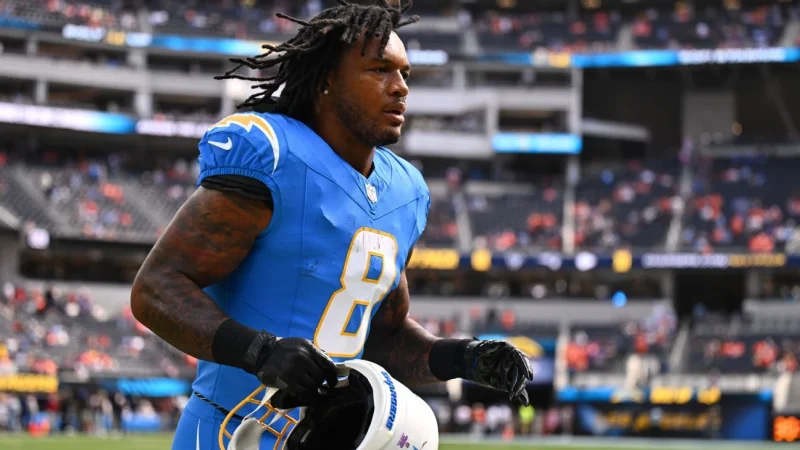
Omarion Hampton’s role has shrunk fast. After logging 40 snaps and a career-high 23 carries in Week 2 against the Las Vegas Raiders, the Los Angeles Chargers gave the rookie running back 20 snaps in Week 5 against the Denver Broncos, his lowest total in the backfield rotation.
The drop matters because Hampton was drafted to be a centerpiece. The Chargers took him with the No. 22 pick in the 2025 NFL draft and saw a physical runner who fit Jim Harbaugh’s teams and could grow into a three- or even four-down back alongside Justin Herbert. Instead, the charger schedule for his workload now runs through a three-man split with Kimani Vidal and Keaton Mitchell, and that split has changed week by week.
The numbers show how quickly the usage turned. Hampton fell to 27 snaps against the Buffalo Bills in Week 3, then to 22 against the Seattle Seahawks in Week 4 before landing at 20 against the Broncos. Against Denver, he had the fewest offensive snaps among the running back room, while Vidal played 26 and Mitchell 21. Through five games, Hampton still leads the team with 73 carries for 271 yards, but that pace comes with less efficiency than last season, when he had 66 carries for 314 yards through the same stretch and a higher rush success rate.

That is why the usage looks so jarring next to what Harbaugh has said about him. He described Hampton as playing “extremely well in all phases” and said the Chargers have three outstanding backs. He also said the rotation was what the team thought was best and that the club wanted to use the skills of three running backs who are all playing good. Hampton’s Week 2 fumble against the Raiders, his second of the season, is part of the picture, but it does not fully explain the scale of the reduction on its own.
The larger answer is in the way the Chargers are managing the season. They are not treating one runner as the weekly fix. Hampton came to the team after a rookie campaign that included a fractured left ankle early in the season and a right ankle injury late in the year, then finished with 545 yards and a team-high four touchdowns. The Chargers still value his power, but the current version of the backfield is built around sharing work, not handing him the entire load.
That leaves Hampton in a familiar but uncomfortable spot: productive enough to matter, not locked into the snap count his draft status suggested. If the Chargers keep leaning on Vidal and Mitchell, the next weekly decision will show whether Hampton’s reduced role is a temporary adjustment or the new normal in a backfield that now belongs to three players.