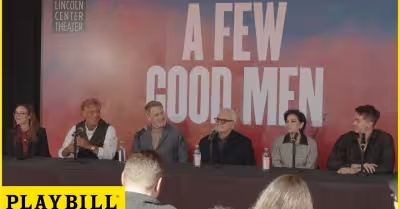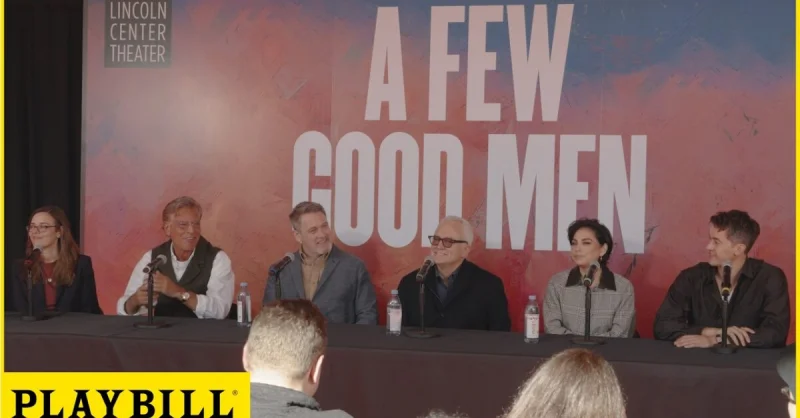
On Oct. 29, the first Broadway revival of A Few Good Men opens at Lincoln Center’s Vivian Beaumont Theater, and Aaron Sorkin has already gone back into the script. He said Michael Arden, who proposed the production, gave him permission to write another draft, turning the revival into something more than a simple transfer of a famous courtroom drama.
Sorkin said he does not believe scripts are ever truly finished. They are, as he put it, only taken away when someone says, “Pencils down.” That is why he was willing to keep working on a play that first became a hit on Broadway in 1989 and later became one of his best-known films in 1992, led by Tom Cruise and directed by Rob Reiner.

The new staging returns to the same hard-edged framework: a court-martial investigation into two U.S. Marines accused of killing a Private, with Joanne Galloway trying to push Daniel Kaffee toward a lead that could implicate Colonel Nathan Jessep. Bradley Whitford plays Jessep in the revival, while Tom Blyth plays Kaffee and Krysta Rodriguez plays Galloway. Blyth called the role his Broadway debut and said he has seen headlines about Pete Hegseth’s military that make the material feel close to the present; Rodriguez said her character is outranked by Kaffee in the military but sits second on the legal team, where she is insulted constantly, diminished and told no.
That immediacy is part of why Sorkin says the play needed another draft or two. He said Michael Arden let him add a subtle lantern to the script’s search for decency, and Whitford said he wishes he lived in a world where the play was not so terribly relevant again. Sorkin also said he did not simply set the new draft in the present day, because Guantanamo Bay has become a detention facility for migrants, which makes a direct update harder to sustain without breaking the logic of the story.
That leaves the revival with a sharper task than nostalgia. It has to carry the weight of a title audiences already know while making room for a question Sorkin still wants the play to ask: whether law and civil structure can hold, or whether fear keeps pushing the argument toward force. For this revival, he chose revision over reverence, and that is the change that matters most.