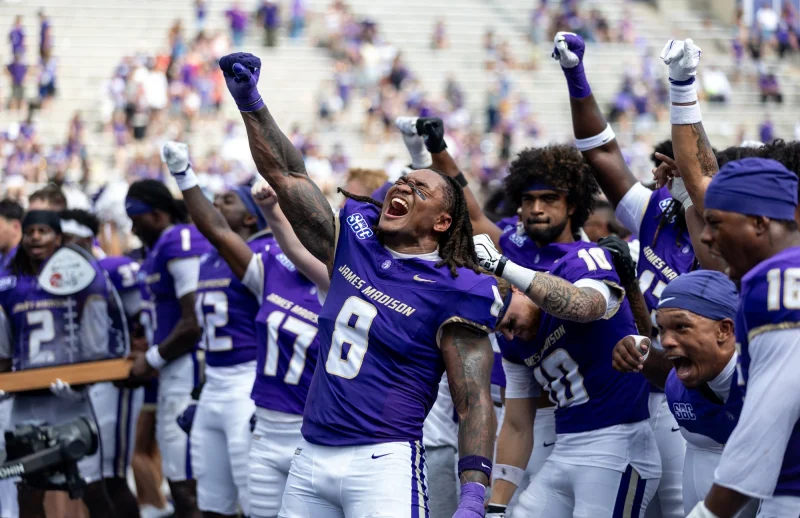
James Madison football walks into Saturday night with a record that would have sounded improbable not long ago: 42-10 since moving up to the Football Bowl Series. That run carries the program to Snapdragon Stadium against San Diego State, and it comes with the kind of financial backing that has turned JMU into one of the best-resourced athletic departments outside the power conferences.
Sean Lewis, who is preparing his team for the matchup, put the logic bluntly. “Follow the money,” he said. “You’ve got to have money to pay for the talent,” he added, then asked, “How important is oxygen to breathing?”
That is the point with JMU. The school in the Shenandoah Valley has gone from a women’s college 60 years ago to a public university fielding a football team that made a trip to the College Football Playoff last season. It once recruited men standing in class registration lines to form its first football team, played home games in a 12,500-seat stadium 15 years ago and belonged to the Colonial Athletic Association and the Football Championship Series five years ago. Now it is traveling to face San Diego State, another heavily funded non-power-conference program, with a roster built to contend immediately.

The money is coming mostly from students. In 2024-25, James Madison students contributed $58.1 million to athletics, and student fees accounted for 73% of the department’s budget. That share was 78% the year before and 79% two years ago. Students pay a mandatory annual auxiliary fee of $6,222, including $2,581 for athletics, whether or not they care about college sports. JMU games are free except for football, men’s basketball and women’s basketball, and a season ticket to those three teams costs less than $500 combined.
That funding model helps explain how JMU can keep pace with programs that have deeper alumni pockets and longer athletic traditions. The school’s revenue from television rights, tickets, sponsorships and donors was $12 million in 2024-25, far below the student contribution total, and its overall athletics budget reached $78.8 million. In the same period, San Diego State had the second-largest athletic budget among non-power conferences, while JMU ranked seventh. The Sun Belt Conference typically distributes only about $2 million a year to each of its members, which leaves schools like JMU leaning far more heavily on fees than league money.
That balance is the friction in the story. James Madison has built a winning football program while public students in Virginia shoulder most of the cost. The university’s student contribution has more than tripled over the past two decades, even as the program’s rise has been tied to coaching turnover and those same fees. Curt Cignetti helped set the standard before he moved on, Bob Chesney followed before leaving for UCLA, and Billy Napier is now the current coach after four years at Florida. Lewis, whose own answer starts with money, said the roster depth issue is simple: if a team does not have the resources to build depth for all that happens across a season, knowledge alone is not enough.
JMU has found a way to win with that model. Whether it can keep doing so without asking students to keep paying more is the question hanging over a program that is already operating like a heavyweight.