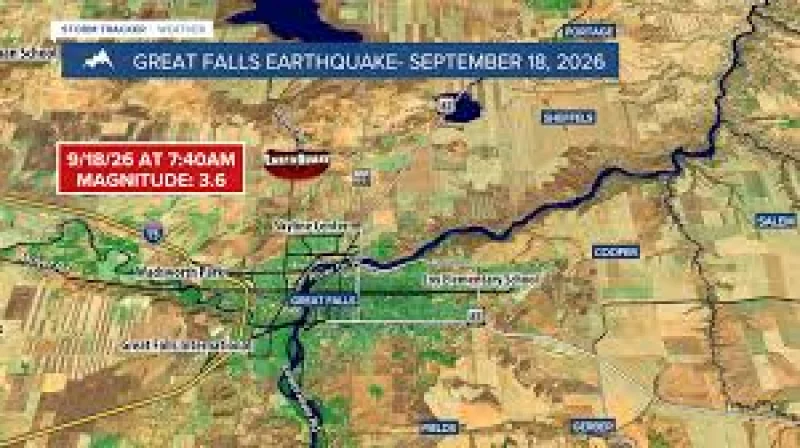
A 3.6 magnitude earthquake struck just north of Great Falls on Friday morning, shaking the region again after a string of quakes earlier this year. The U.S. Geological Survey said the tremor hit at 7:40 a.m. and was centered about 3.1 miles northwest of Black Eagle at a depth of about 17.2 miles.
For people in and around Great Falls, the reason it is being searched now is simple: this was the latest in a series of earthquakes that have broken up an otherwise quiet stretch. The January 29 quake measured 4.2 magnitude, and smaller quakes followed later that day and in the weeks after, including events on January 31, February 12 and February 26.
The Friday quake was the first in several months, but it was not the first sign of movement. The earlier sequence included a 2.7 quake later on January 29, then quakes of 3.2, 3.7 and 2.8 magnitude on the later dates this year. Together, those events point to a cluster rather than a single isolated shake.

No injuries were reported in any of the incidents, and no serious damage or impacts on infrastructure were reported. That is the part that matters most for Great Falls: the shaking returned, but it did not bring the kind of disruption that turns a short-lived seismic event into a longer emergency.
There is one detail that keeps the picture from being perfectly neat. The September 18 quake was described as probably an aftershock, but not as a definitively confirmed one. In practical terms, that means it fits the pattern of the earlier quakes without closing the case completely on whether it belongs to the same sequence.
So the answer for now is clear enough for residents and open enough for scientists: Great Falls just felt another small quake, and the broader series that began in January still appears to be the best explanation. What remains unresolved is whether the September 18 event will be treated as part of that same aftershock chain or simply as the latest separate jolt in the region.