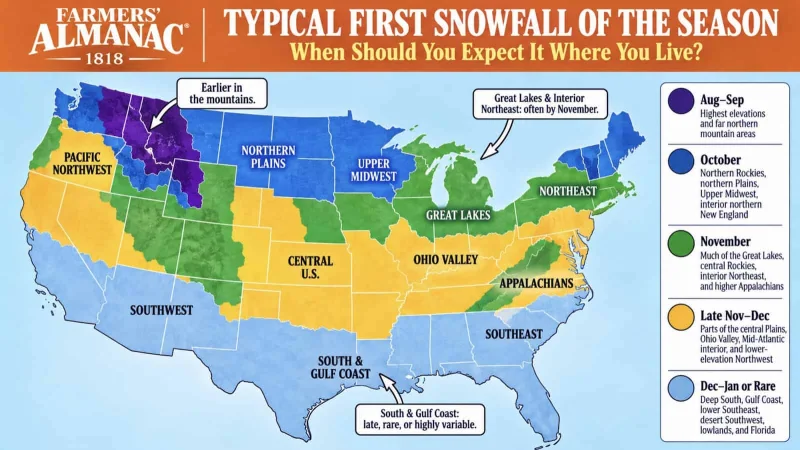
The Farmers' Almanac has put out its latest first-snow map, and the message is simple: in New England, the first flakes are typically expected in October, while the Northeast usually sees them in November. That September update gives a regional answer to the question many people ask as summer fades, even if the exact first dusting still depends on the weather.
The timing matters because snow does not arrive everywhere at once. The same update says higher elevations in the northwest part of the country can start seeing snow in August or September, while the Northern Plains, the Upper Midwest and New England usually move into first-flake season in October. The Great Lakes, the Northeast and higher elevations in the Central Rockies follow in November, with the Central Plains, Mid-Atlantic interior, the Ohio Valley and lower-elevation parts of the Northwest more likely to wait until late November through December.

For people trying to read the season ahead, the map is less about a single storm than a broad pattern. It separates first flakes from snowfall accumulation, which is why the same place can be listed as a snow area without promising a measurable cover on the ground. That distinction is what gives the chart its value: it is a timing guide, not a forecast for how much snow will stick.
Still, the map is not landing evenly with everyone. Several commenters pointed to places such as Colorado, Washington, middle Tennessee, Arkansas and southern Missouri and said the timing looked off. That pushback underscores the limits of any wide regional guide, especially when local weather can break the pattern from one year to the next.
The broader backdrop is less forgiving than the calendar. Climate Central has said winter is the fastest-warming time of year for most of the United States, and rising global temperatures can make snowfall patterns harder to predict. In that setting, the Farmers' Almanac update works best as a seasonal marker: the Northeast is now on notice that the first flakes are supposed to arrive in November, but the exact day the sky turns white will still be decided by the weather, not the map.