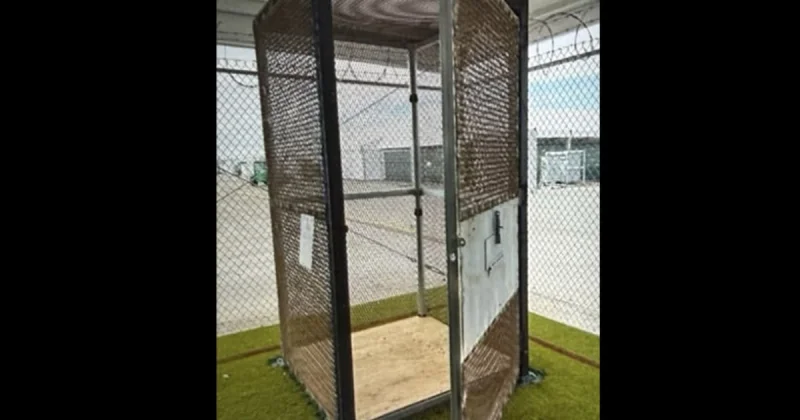
A Department of Homeland Security watchdog says some immigrants detained at Florida’s now-shuttered Alligator Alcatraz were held in outdoor cages slightly larger than telephone booths for more than an hour at a time. The report describes metal enclosures about 4-by-4 feet, or 16 square feet, a size far below the 37 square feet ICE says is the minimum for a room meant for one person.
The finding is landing now because it is the first government report to put official detail behind the cramped cages inside the Everglades facility, which opened in July 2025 and quickly became a flashpoint. The watchdog’s inspectors visited in January under a Congressional mandate, and their report now gives a new accounting of what people inside say happened to them at a site that was built by Ron DeSantis’ administration and nicknamed Alligator Alcatraz by Florida’s attorney general.

Facility staff members described the outdoor enclosures as “calming areas” meant for detainees “to de-escalate and have time alone.” The report says the facility also had indoor cages measuring 18 square feet. Taken together, the numbers leave little room for interpretation: these were not standard holding rooms, but small metal cells used to confine people for stretches long enough to matter, even as officials framed them as a way to manage behavior.
The report lands against a different account from Homeland Security. The department said it did not have authority over day-to-day operations at the site and said the 287(g) agreement did not give the federal government authority over the physical operations of any detention facility. But the same report notes that ICE personnel were on site, and detainees were given an ICE handbook that said Alligator Alcatraz was a facility of the United States. That overlap between a state-run site and federal involvement is now the sharpest fault line in the case.
That is also why the watchdog’s finding matters beyond one shuttered facility. Amnesty International had already published a December report, based on detainee interviews and a tour of the site, saying the cages were used to punish detainees and amounted to torture. Now a federal review has confirmed the existence of the cages themselves, even if it stops short of saying how many people were put inside them over the life of the facility. What remains unanswered is the full scale of their use — how many detainees passed through those outdoor and indoor cages before Alligator Alcatraz was closed down. For now, the record shows a facility that opened fast, operated in tight quarters, and is now gone, but not before leaving behind a paper trail that will be hard to ignore.