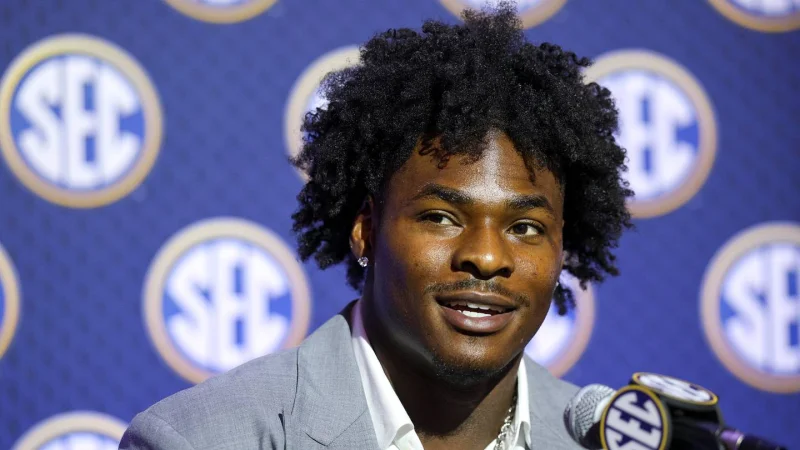
Will Muschamp’s first game in this stint as Texas defensive coordinator came with a clear change: Colin Simmons was not just rushing the passer. On Saturday, Texas held Texas State to seven points, and Simmons took five snaps as an off-ball linebacker while still spending most of his time on the edge.
That matters because Muschamp was not starting from scratch. His plan shared a lot with Pete Kwiatkoski’s, but it also pushed Simmons into roles he had almost never filled before. Across his first two seasons at Texas, Simmons had taken off-ball linebacker snaps on only five percent of his plays. On Saturday, he got five of them in one game, and the usage was deliberate enough to show up in the first series of the Mint front.

Simmons spent around 80% of his plays in a seven- or loose five-technique outside the offensive tackle, which kept him in the job Texas has mostly asked of him. But Muschamp also used him as a quarterback-spy and as a looping blitzer, then shifted him into the Mint front. In that alignment, the jack linebacker has pass coverage responsibility while the off-ball money linebacker rushes no matter what. Muschamp put Simmons at the money spot and used Rasheem Biles as the jack for the first three plays Texas was in Mint.
That is where the wrinkle shows up. For a defense that looked familiar in broad shape, the details changed how Simmons was deployed snap by snap. The Mint front created one set of duties, the spy look created another, and the blitzer role gave Muschamp a way to keep one of Texas’ most disruptive players moving instead of locking him into a single lane.
The first question now is not whether the plan worked on Saturday; Texas gave up seven points, and it did. The question is how far Muschamp will take it. Simmons has been mostly a prototypical edge rusher, but this game showed that his value can stretch beyond the tackle box. If the same mix returns, Texas may spend more than one game asking him to be both the rusher and the answer to the offense’s next move.