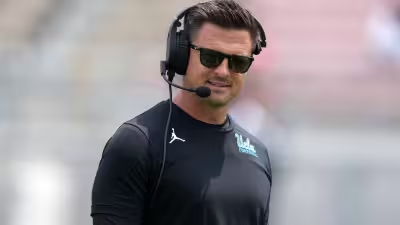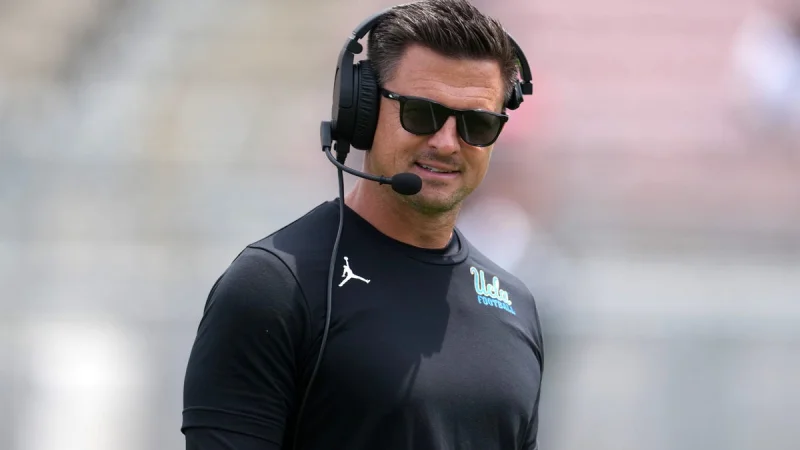
UCLA is heading into Saturday night’s opener against Cal with Nico Iamaleava as the fixed point and everything else still moving around him. The quarterback practiced Wednesday, and the Bruins are planning to keep shifting personnel groupings around him as they try to build an offense that can change shapes without losing its footing.
That plan has become more important because UCLA is still holding its depth chart back as long as possible. Dean Kennedy said the offense starts with the quarterback, and he described Iamaleava as carrying "a juice and aura about him that’s like, ‘I’ve put in a lot of work up into this point,’" while adding, "He’s beyond confident and everybody is too." For a team opening the season on the road, that confidence matters. So does clarity. UCLA has been more settled up front than in the skill groups, which is why the final pieces of the offense are still being sorted now rather than weeks ago.
What UCLA is building is less about one formation than about what each grouping can hide and reveal. Kennedy said the Bruins rely heavily on optionality, and that is the point of keeping so many moving parts in play. In 12-personnel, Josh Phifer, Harry Lodge or Braydon Loftin can align on the line while the other slides into the slot. Wayne Knight, Jaivian Thomas and Anthony Woods can all be used on running or passing downs, with Knight bringing receiving value after catching 40 passes at James Madison in 2025 and Thomas and Woods offering power through the tackles. In 11-personnel, Brian Rowe Jr., Aidan Mizell and Landon Ellis can stretch the outside, while Ellis and Mikey Matthews can also work from the slot.
That flexibility is the selling point, but it also carries the risk UCLA cannot ignore. Kennedy said the different body types and skill sets create more room for creativity, yet the offense still runs through Iamaleava’s decisions and timing. If he is merely confident instead of deliberate, the moving parts can stall. That is where the biggest connection on the field may come from, especially with Mizell and Iamaleava showing flashes on deep routes and needing sharper timing to turn them into bigger plays. The Bruins do not need the same answer on every snap; they need the right one fast enough.
The line is closer to settled than the rest of the offense. Jordan Davis returned after dehydration briefly kept him out and locked in at left tackle, while Hall Schmidt has drawn praise from Chesney for being "solid" and "playing with an edge." Carter Sweazie and Eugene Brooks are set at the guard spots, and Riley Robell is back from a knee injury and in line to play center. Wayne Knight said Robell will keep the unit on the "same page," and described him as a player with "a lot of tenacity, but poise at the same time."
That gives UCLA a workable frame for the opener, but the test comes immediately. The Bruins travel north to play Cal on Saturday night, and the first real answer on Bob Chesney’s offense will come from how quickly Iamaleava and the rotating skill players settle into the timing the scheme demands. If that connection is there, UCLA’s flexibility becomes an advantage. If it is not, all the creativity in the world will only make the delays more obvious.
For more on UCLA’s longer-range outlook, see Ucla Football turns to Bob Chesney as 2026 outlook shifts sharply.