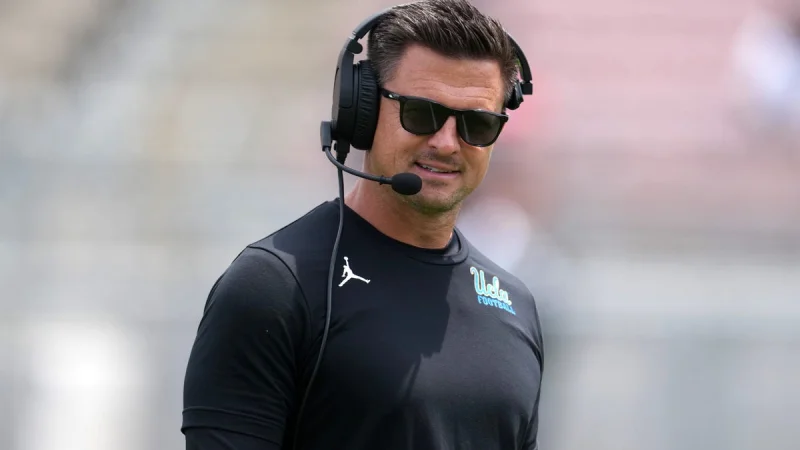
UCLA’s offense is heading into Saturday night with Nico Iamaleava at the center and a lot of moving parts around him. The quarterback drew attention at practice on Wednesday, and UCLA is taking that same approach into the opener against Cal: start with Iamaleava, then build the rest from the looks and matchups he can create.
That is why the search around the UCLA football coach is really a search for structure. Dean Kennedy said the offense begins with the quarterback, and he has spent prep week shaping a plan that leans on optionality rather than a fixed script. UCLA is also holding its depth chart as long as possible, a sign that the staff still wants room to sort out how the first waves of snaps will be distributed when the game starts.
Kennedy said Iamaleava had a “juice and aura about him” that suggested he had put in a lot of work to get to this point, and he said the quarterback was beyond confident. Those traits matter because UCLA is not asking him to manage a narrow playbook. It is asking him to drive one that can shift between two-tight end sets, three-wide receiver sets and other personnel looks without losing tempo or clarity.
The line already looks closer to settled than the skill group behind it. Jordan Davis returned to practice after dehydration briefly kept him out and is locked in at left tackle. Hall Schmidt has lined up at right tackle, and Chesney praised him as solid and said he plays with an edge. Carter Sweazie and Eugene Brooks are set at the guard spots, while Riley Robell will play at center after coming back from a knee injury ahead of Saturday’s opener. Wayne Knight said Robell keeps the line on the same page and plays with tenacity and poise at the same time.
The real variable is how those pieces get layered together once the ball is snapped. In 12-personnel, Josh Phifer, Harry Lodge or Braydon Loftin can line up on the line while the other moves into the slot. Wayne Knight, Jaivian Thomas and Anthony Woods can all be used on running or passing downs, and Kennedy said the variety of body types and skill sets “leads to creativity.” In 11-personnel, Brian Rowe Jr., Aidan Mizell and Landon Ellis can work on the outside, while Ellis can also move inside with Mikey Matthews.
That flexibility is the upside. The friction is that UCLA says it has a good idea of how the reps will work, but Kennedy also said the staff does not know what kind of game it will be in. If the opener against Cal turns into a clean, controlled script, the Bruins can lean on the packages they have already mapped. If it becomes something messier, the offense will have to show how quickly Iamaleava and the rest of the unit can adjust without losing the edge that has been building all week.
There is enough here to think UCLA will have options when it needs them. The sharper question is whether the timing can catch up fast enough for Iamaleava and the receivers around him to turn those options into the kind of plays that decide a season opener.