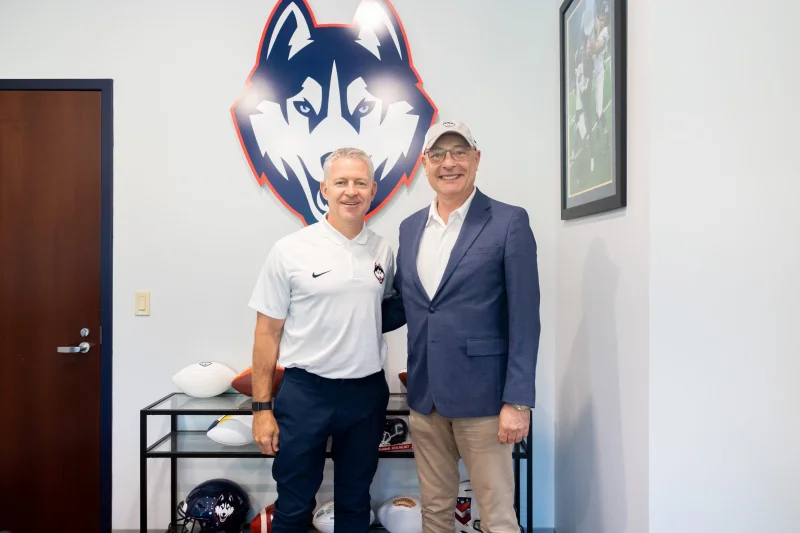
Jason Candle is beginning his first season as UConn’s head football coach, and he is making the same point in the opening weeks that he made on the field at Toledo: the work that happens off it matters just as much. In a recent August conversation with Pamir Alpay, UConn’s Provost and Executive Vice President for Academic Affairs, Candle said student-athlete success has to include academics and the routines that support it.
That message lands now because Candle is new to Connecticut, new to Storrs and new to the demands of a program trying to define itself under a different voice. He moved with his family in June, and the first public picture of that transition came during a recent August morning when he and Alpay spoke while the team did yoga on the indoor practice field at the Burton Family Football Complex in Storrs. The image fit the message: this is a coach introducing himself through process before results.
Candle brings that message with a resume that would normally be measured in wins. He spent 10 seasons at Toledo, where he won 81 career games, claimed two Mid-American Conference championship titles and reached seven bowl game appearances. Even more telling for a school that watches the full student-athlete experience, Toledo’s football program surpassed a 3.0 GPA in nine seasons under his leadership. For UConn football, that background gives weight to what might otherwise sound like a standard speech about balance.

He framed that balance as a simple fact of life: if athletes are investing in a sport or another extracurricular pursuit, they also need to understand the degree they are building toward. Candle said you cannot have one without the other, and he tied high achievement to the way someone wakes up, organizes the day and handles the next task after both success and disappointment. In his telling, the goal is not to celebrate the A on a test or the win on a given Saturday, because the next day brings another challenge anyway.
That is where his early message runs against the usual grammar of college football. Coaches are judged by the scoreboard, yet Candle said wins are not his primary focus in the way many fans might expect from a head coach. He is asking players to see the field as part of a larger project, not the whole point of it, and that is a harder sell when the pressure on a first-season coach is usually to show immediate progress in the standings. His pitch is that the habits that produce a degree also produce a steadier program.
For UConn, that is not a cosmetic detail. The school describes itself as Connecticut’s flagship R1 public research university, and Candle is stepping into a setting where academic success is supposed to sit alongside Division 1 athletics rather than behind it. He said the adjustment to Connecticut has felt smoother than a long-tenured move might suggest, crediting the people around him after relocating with his family in June. What remains unresolved is the standard he will be measured against first: the public number on the scoreboard, or the quieter standard he keeps returning to in the classroom and in daily routine.