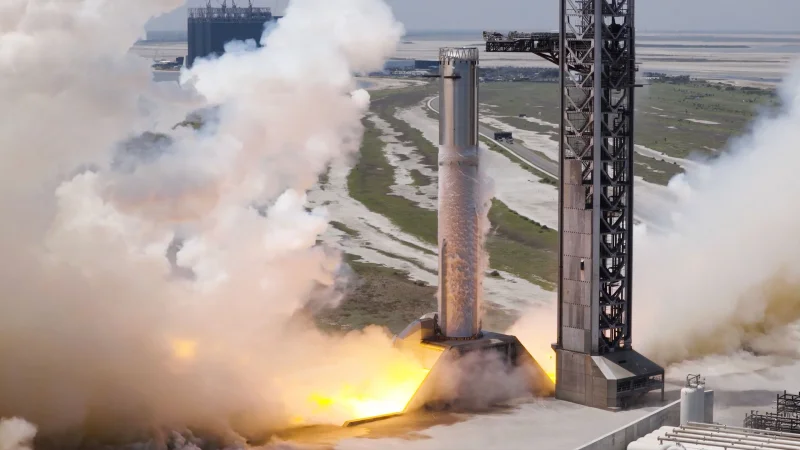
Super Heavy Booster 21 cleared a key test for SpaceX’s SpaceX Starship Flight 14 on August 28, firing all 33 Raptor engines in a 15-second static fire that marks the last major ground hurdle before stacking and launch clearance.
That is why the mission is drawing fresh attention now. Flight 14 is the next step people are watching because it is expected to be Starship’s first attempt at a true orbital trajectory and to carry roughly 20 operational Starlink V3 satellites. Elon Musk said in early August that the flight would try the first-ever launch tower catch of the Starship upper stage, but later reporting suggests that catch has been pushed back.

The booster’s test campaign moved quickly after that ignition. On the morning of August 29, Booster 21 went through a chopsticks test at Starbase’s Pad 2 launch tower, rising off the Orbital Launch Mount to the top of the tower before being lowered onto a booster transport stand. Ground crews removed that stand before propellant loading, and about 30 minutes after that loading began, LabPadre cameras captured the ignition event.
The result leaves the mission in a narrow holding pattern. The 33-engine static fire was described as the final major ground test before Booster 21 can be stacked with Ship 41, and FAA sign-off is still one of the remaining gating items. SpaceX has not announced an official target date for Flight 14, even though the testing window for Booster 21 ran from August 24 to September 5.
There is also a second question still hanging over the flight: whether the booster catch at the Mechazilla arms will actually be attempted. A Super Heavy booster catch may still be on the table, but the upper-stage catch Musk talked about is no longer being treated as locked in. For now, Booster 21 and Ship 41 have done what they needed to do on the ground. The launch itself still depends on stacking, and on whether the FAA gives SpaceX the last word it needs.