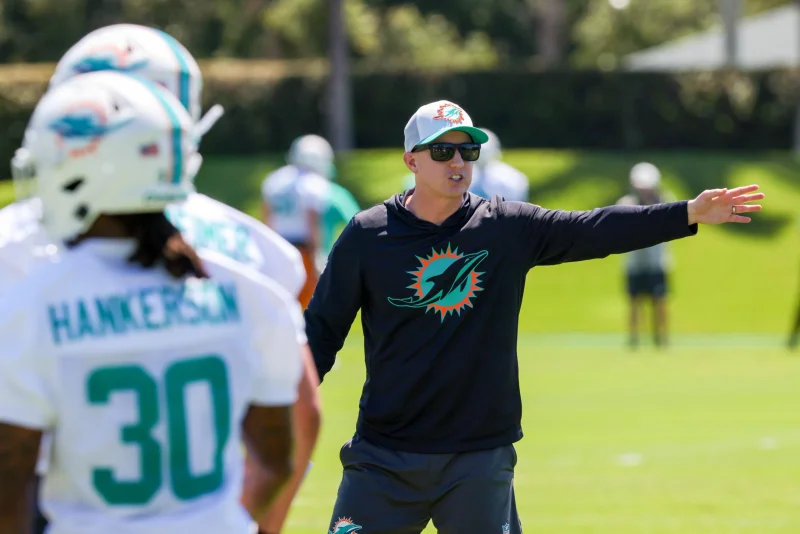
The Miami Dolphins opened preseason with an offense that looked nothing like the one they used in 2025. Miami pushed the ball far deeper, cut back sharply on shotgun, and leaned harder on 12 personnel in the first real look at Bobby Slowik’s version of the attack.
Those changes were not subtle. Miami’s air yards per attempt on first-half early downs jumped to 12.1 from 6.0 a year ago, a pace that would have ranked first in the NFL last season. The shotgun rate on early downs fell to 28% from 68%, while 12 personnel usage rose to 32% from 9.5%. For a unit expected to look very different in 2026, that is the clearest signal yet that the Dolphins are testing a new structure rather than simply changing a few calls.
That is why the search for Chris Johnson NFL is landing on this team now. Mike McDaniel was dismissed this winter, and Jeff Hafley picked Bobby Slowik to take control of the offense after two years as an offensive coordinator and a background in the Kyle Shanahan coaching tree. The first preseason game offered the first clean measure of what that handoff might mean in practice: more under-center work, more tight ends, and a willingness to throw farther down the field.
Malik Willis is part of the reason that shift has drawn attention. His more prolific arm gives Miami a reason to test a deeper passing game, and the opener suggested the Dolphins may be preparing for that possibility. But one preseason game can only say so much. A single sample can show intent, not proof, and multiple data points will be needed before anyone can call this a real trend.
The next look comes this weekend against the New York Giants, and it should tell whether this was a one-game experiment or the first sign of a regular-season plan. If the Dolphins stay near these numbers, the offense will not just look different in 2026. It will be built around a different idea of how Miami wants to move the ball.