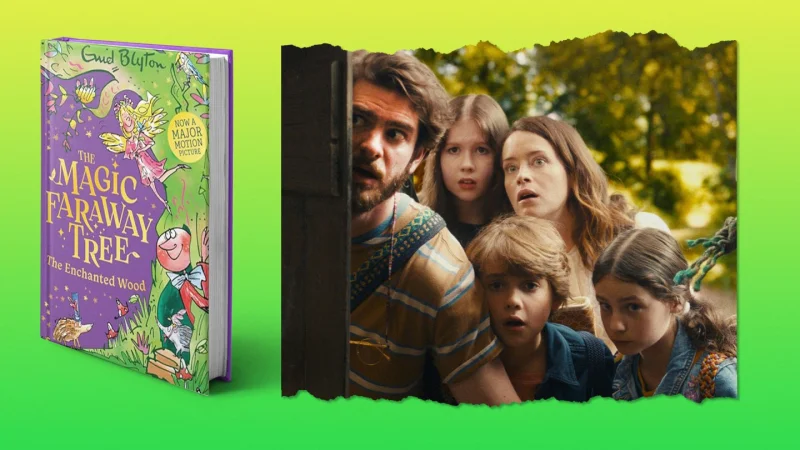
The Magic Faraway Tree has arrived with a starry cast and a review that is far less enchanted than the title suggests. The film, based on Enid Blyton’s children’s novels, is being described as rooted in twee storytelling and light on the kind of magic that should carry a family movie.
That judgment matters now because the adaptation is being measured as a fresh screen version of a 1943 book and a broader series, not just as a one-off children’s tale. Andrew Garfield and Claire Foy play the parents of three children, while Lenny Henry, Simon Russell Beale, Jessica Gunning, Jennifer Saunders and Judi Dench fill out a cast built to suggest warmth, wit and wonder.
Instead, the film is said to work like a machine that knows where its parts should go but not how to make them sing. The screenplay is by Simon Farnaby, who also wrote Wonka and Paddington 2, yet this time the result is described as mechanical and short on magic. Even with a running time of almost two hours, the reviewer says it appears to be missing massive chunks of information, including enough of the book’s mythology for a newcomer to keep up.

The story itself has enough moving pieces to explain the strain. Beth, the eldest daughter of Tim and Polly Thompson, is played by Delilah Bennett-Cardy, with Phoenix Laroche as Joe and Billie Gadsdon as Fran. Tim is a goofy stay at home dad, Polly quits her job, and the family loses the house, car and other amenities owned by her former company before moving into a decrepit farmhouse in the middle of nowhere, where the barn has no running water or electricity. Beth writes to Polly’s mother for help, and the magic faraway tree in the enchanted forest nearby becomes the route into the film’s fantasy world. Fran finds it after receiving a letter thanking her for returning a fairy’s purse, and the human-size fairy Silky, played by Nicola Coughlan, appears as part of the machinery of enchantment.
That is where the film’s main problem shows through. It wants the gloss of a beloved children’s property and the comfort of familiar British performers, but the review says it never quite opens the door to the mythology it depends on. The comparison to Willy Wonka and other Roald Dahl films only sharpens the contrast: those stories can feel eccentric without feeling empty, while this one is described as twee rather than truly magical.
For readers deciding whether to bother, the answer is narrow and clear. Fans of the books will fare best, and kids 8 and below may also find it endearing. Everyone else is being asked to enjoy a nearly two-hour adaptation that, by this account, offers the shape of wonder more than the thing itself.