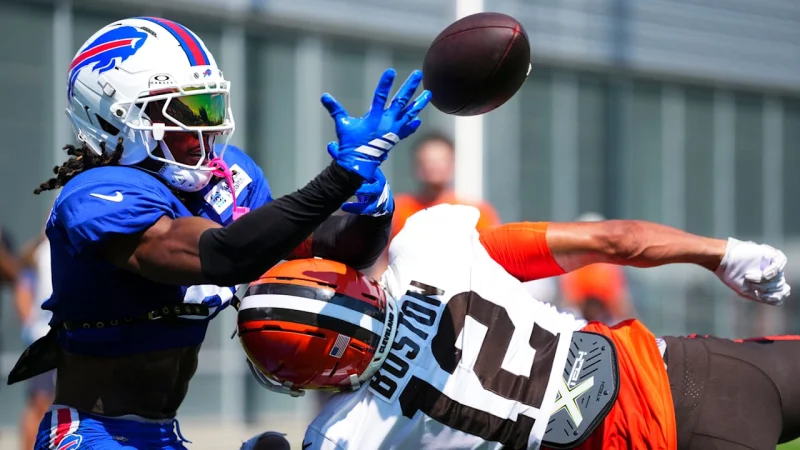
Men’s NCAA football is not near the top of the injury-rate list, even though it still produces one of the largest raw injury totals in sports. A new study by Davidoff Law Personal Injury Lawyers placed football 13th among 55 sports, with an estimated 4.6 injuries per 1,000 hours.
That result lands in a season when Damar Hamlin remains the face of football’s most frightening risk. Hamlin suffered a cardiac arrest on January 2, 2023, during a Monday Night Football game against the Cincinnati Bengals, and his case still shapes how many people think about the sport. This new ranking does not erase that memory. It just shows why the question of danger changes when time on the field is part of the math.
The study’s numbers make that point plainly. Men’s football was estimated to produce 47,199 injuries annually in the United States, the highest raw total in the analysis, but that figure comes from a sport with far more participation time than many others. Once injuries are measured per 1,000 hours, MMA led all 55 sports at 114.4, followed by Rugby Sevens at 71.6 and Rugby Union at 46.8. Karate, Taekwondo and amateur boxing were all above 38 injuries per 1,000 hours, while motocross came in at 22.7, Judo at 22.0 and novice running at 17.8.

Ruben Davidoff said the instinct after an injury is to ask whether a rule was broken or whether negligence played a role, but he argued the numbers point somewhere else in some sports. “When an athlete gets hurt, the first question is often about the rules,” he said. “Did someone break a rule? Was there negligence? But the data shows that in some sports, the rules themselves are the problem.”
The friction is in the gap between volume and rate. Football’s raw injury total is high because so many athletes play it, yet that does not make it one of the most injury-prone sports on a per-hour basis. Men’s NCAA wrestling rounded out the top 10 at 6.6 injuries per 1,000 hours, with an estimated 7,510 annual injuries, and men’s ice hockey was estimated at 3,684 annual injuries. The comparison suggests the better question is not simply which sport records the most injuries, but which one turns each hour of play into the greatest risk.
That is why this study matters now. It gives a cleaner way to measure danger, and it complicates a sports debate that often stops at the biggest total. For Hamlin, and for anyone still thinking about what happened on that field in January 2023, the new ranking does not soften football’s image. It sharpens the difference between spectacle, participation and actual risk.