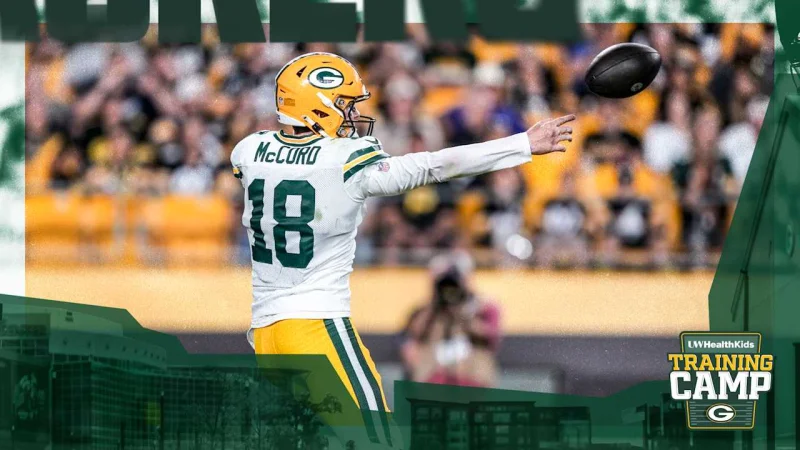
Kyle McCord’s evaluation lands on one hard truth: he can do many quarterback things well, but raw arm talent is still the issue that defines him. The scouting view is that his accuracy, pocket poise and willingness to make big throws give him a real backup-quarterback profile, yet his arm strength and release speed keep him from looking like more than that.
That question matters now because McCord is being measured against a standard NFL teams use to separate playable backups from quarterbacks who can survive when the picture gets messy. On a 20/80 scale, a starting NFL quarterback needs to sit around 50, while backups can live in the 35-to-45 range. McCord’s arm is being placed near Tua Tagovailoa and Brock Purdy, which puts him in a workable neighborhood, but not in the top tier of arm talent.
Brugler’s description in The Beast is straightforward: McCord has solid arm talent, throws with adequate velocity and can add some arc when needed. That matches the broader view of him as an extremely accurate quarterback at Ohio State and at Syracuse, with very good ball placement that pushes toward elite. He is not a runaway athlete, but he can move enough to pick up a first down here and there. He also does not back away from pressure in the pocket and will step up when it makes sense.
The problem is that the traits he lacks are the ones that are hardest to manufacture later. A fast release can help a quarterback compensate for average arm strength because the ball comes out before windows close, but McCord is not described that way. Instead, the report groups him with quarterbacks who do a lot of soft things well and still need their arm to hold up. Matt Flynn was praised for being strong in the details even with a borderline arm. Scott Tolzien was smart, but could not push the ball at all. Josh Allen, by contrast, sits on the other end of the scale with an incredible arm, while Malik Willis is framed as a hyper-athlete with an absolute cannon.
That comparison leaves McCord in the middle, where accuracy can keep him relevant and arm talent can limit how far he goes. He trusts himself to make big throws, and that confidence is part of why he remains interesting as a backup option. What is not clear is whether any mechanical change can give him the faster release that would make his arm profile easier to live with. For now, the judgment is simple: McCord has enough to be on the board, but not enough to remove the concern that defines him.